On this page (9)
Yes, you can grow garlic in a container — and the pot, not the plant, sets the limits. Garlic is a shallow-rooted crop 5 that will bulb up in a bucket, a grow bag, or a half-gallon pot. What separates a pot of garlic from a pot of garlic-flavoured disappointment is three things: how much soil the container holds, how cold its roots get in winter, and how fast it runs dry.
The rest — mix, feeding, planting depth — is easier to fix than those three, so this page takes them in order after a short setup. It uses two Chinese container growers, the RHS garlic guide, Maryland's container guide, an NC State extension garlic page, and Nevada's page on overwintering containers, with Minnesota, Iowa State, and Purdue behind the growing and cold-injury detail. Where those sources disagree, we say so; where they stop, we say that too.
What a workable setup looks like
Mix. The RHS version for containers is plain: a peat-free multi-purpose compost 7. The bag grower mixes peat, coir, and perlite and fills the bag to about 80 percent 2; the pot grower starts from garden soil with two to three centimetres of compost or aged manure in the bottom and rapeseed cake as base fertiliser 1. All three work. Two constraints from the extension side: the mix has to drain and hold moisture at pH 6.0–7.0 4, and garlic dislikes soil below pH 6 7 — the two statements agree.
Drainage, specifically. Every container except a self-watering type needs holes or slits in the bottom 8. Maryland is blunt about two habits that do not help: gravel or broken pot shards in the bottom do not improve drainage and can raise the water table instead 8, and a pot left sitting in its saucer keeps the water it just drained 8. Raise the pot on feet or a brick instead 8. Two material notes that matter later: porous pots — clay, ceramic, concrete, wood — dry out faster than plastic or metal, and dark colours run hotter 8.
Cloves. Large and undamaged, base down, pointed end up 1, 2. The papery wrapper can stay on or come off 9. The bag grower discards cracked cloves outright, because they rot once they are in the mix 2.
Planting depth. The figures run from 2.5 cm to 8 cm, and the sources explain why. The RHS puts the tip 2.5 cm (1 in) below the surface, deeper in light soil — which can give larger bulbs — but not deep in heavy soil 7. NC State says one to three inches 9. The bag grower covers five to eight centimetres 2, the dense tray about five 3, and Minnesota's field figure is two to three inches from the base of the clove to the surface 4. In a free-draining container mix, the deeper half of that range is the reasonable default — our reading of the RHS's light-soil note, applied to a potting mix.
Water in, then shade. Water thoroughly after planting 2, 1. The pot grower keeps the container out of full sun until green leaf tips appear, on the grounds that early sprouting needs no light and direct sun can shrivel the clove 1. That is his practice rather than an extension recommendation, but it costs nothing to follow.
Timing. Autumn: mid-autumn to early winter in the RHS guide 7, September and October for both Chinese growers 2. Plant later than October and the shoots wait for spring 2. The RHS also gives the reason for autumn planting — most varieties need one to two months at 0–10 °C (32–50 °F) to form a good bulb 7. For the right window where you live, use the zone calendar rather than a fixed month.
Limit 1: soil volume, and two guides that disagree on depth
The first real conflict is depth, so here is the whole picture.
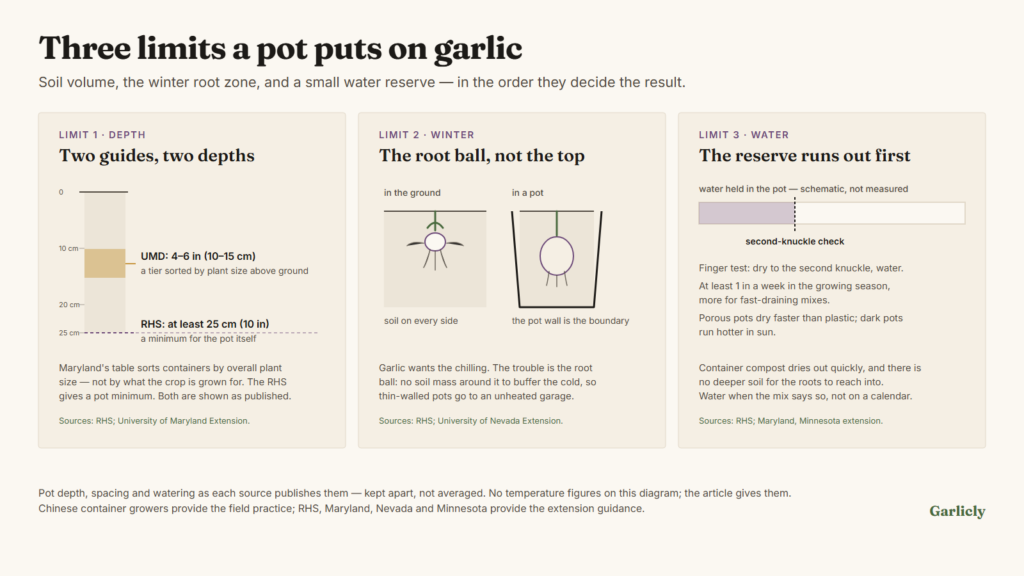
The RHS says pots should be at least 25 cm (10 in) deep, and that the pot's width and length decide how many cloves fit — plant at the same spacing and depth you would use in the ground 7.
Maryland's container guide works from a size table. It puts garlic in the "small vegetables or flowering plants" tier — minimum 1–3 gallons of growing media, 4–6 inches deep — in a list with basil, cilantro, radish, and scallions 8. In the same table, large vegetables get 12–16 inches and medium ones 8–12 inches 8.
Our ruling, and it is ours, not either source's conclusion: 25 cm (10 in) is the defensible minimum; 4–6 inches is too shallow for a crop grown for its bulb. Maryland's table sorts by overall plant size — "match container size to plant size, both the top growth and root system" 8 — and garlic's top growth is grass-like, which is likely why it is filed with the herbs; but the harvest is a head of ten to twenty cloves 9, and that head has to swell in the media. Six inches of media leaves it little room and even less water reserve. If you already own a 4–6 inch pot, grow garlic for leaves in it, not for bulbs.
On how many cloves fit, the spacing figures also spread — and again the context explains most of it:
- RHS: 15 cm (6 in) apart, the same as in the ground 7.
- NC State: 4–8 inches apart, and also 4–8 inches from the edge of the bed or container 9.
- Chinese pot grower: at least 7 cm between plants if bulbs are the goal — below that, his containers produced no bulbs at all — which caps a half-gallon pot at five cloves 1.
- Bag grower: 8–10 cm 2.
The Chinese figures describe dense home growing aimed at a usable bulb rather than a prize one; the RHS figure describes a field spacing. Our reading: treat 7 cm as the floor. If you want bulbs at the RHS's 15 cm, the RHS itself points you to a much wider pot — it pairs the 25 cm depth minimum with the instruction that the pot's width and length decide how many cloves fit 7. A 25 cm-wide pot holds two to four cloves at 15 cm by our arithmetic, which is a fair experiment and not a season's supply.
NC State's 4–8 inches of clearance from the container edge is the one instruction a home pot cannot honour: a 25 cm pot has no 10–20 cm of margin to give. That line reads as written for beds and very large containers, which is how we treat it here.
If you want green garlic leaves rather than bulbs, ignore the density rules entirely: plant almost touching and cut what you need 1, 3.
Limit 2: winter is harder on the roots than on the tops
Garlic wants a cold winter, which is exactly what makes container growing awkward: the plant needs the chilling, but the root ball in a small pot has no soil mass behind it.
RHS puts the requirement plainly: most varieties need one to two months at 0–10 °C (32–50 °F) for good bulb development, which is why garlic is normally overwintered outdoors 7. Minnesota describes what that looks like in a bed — roots and shoots emerge from the clove by the first hard freeze, with shoots staying underground until spring, under three to four inches of leaf or straw mulch that keeps soil temperature from swinging 4.
A pot has none of that mass. Purdue's cold-injury publication says the quiet part: in the landscape, roots are rarely injured because soil and snow protect them, while containerized plants — the page is describing nursery stock, not garlic — are "very susceptible to freezing of the roots, since they are more exposed," and containerized stock whose root ball sits above ground freezes easily 6. Roots are also more sensitive to cold than stems are 6; cold penetrates deeper in sandy and in dry soils than in clay or moist ones 6; and repeated freezing and thawing heaves small plants upward, breaking fine feeder roots 6. A pot cycles freeze–thaw faster than a bed and sits exposed on every side.
Nevada's overwintering page names the container problem directly: small or thin-walled containers are the ones to move into an unheated garage, "so fragile plant roots do not get too cold" 10. It also notes that plastic and metal pots offer little protection for tender roots, and that terracotta and ceramic can crack in a hard winter 10.
So the moves are sourced, even if no page runs them on garlic specifically:
- Group the pots, out of the wind, close to the house — Nevada's version of the same advice 10.
- Move small or thin-walled pots into an unheated garage or shed for the winter 10 — unheated, because the RHS says the bulb needs a cold spell, and a warm room would undo the chilling 7.
- Mulch the surface, which is how Purdue describes insulating a root zone against rapid temperature swings — and remove the mulch again in spring 6.
- Water sparingly over winter so the media does not dry out completely 10; the bag grower's whole winter routine is the same instruction 2.
- No nitrogen in autumn. Purdue notes that late-summer and early-fall nitrogen produces lush, tender growth that cannot harden off before cold arrives 6.
- Bank soil around the pots, or wrap them. These are the two moves the pages above do not cover, and growers use both; treat them as common practice rather than tested advice.
What we do not have is a temperature at which garlic roots in a pot die. No source gives one, so we are not naming one — and none of these pages is a garlic-in-a-pot trial, which is why the measures above are transfers of a documented mechanism rather than a recipe with a guarantee attached.
Limit 3: the water runs out first
The RHS says it outright: "Compost in containers can dry out quickly, so be prepared to regularly check if you need to water" 7. Maryland adds the material split — porous pots dry faster than plastic or metal, and dark pots run hotter 8 — plus the reminder to raise the pot so it can drain 8.
There is still no refill interval in days, and we are not inventing one. What the sources do give is a rate, a test, and an end point:
- Rate: soak the soil to a depth of at least one inch a week during the growing season, and water sandy mixes more often 4. A peat-coir-perlite mix sits closer to the sandy end of that sentence — our reading of the two sources, not Minnesota's words.
- Test: push a finger in; when the mix is dry down to your second knuckle, water. Water on a run of sunny days, skip it when it is overcast or raining 1. In a container this beats any calendar.
- End point: the RHS waters during dry spells in spring and early summer to help bulb size, then stops once the bulbs are large and well formed, because late water encourages rot — and yellowing foliage is the signal that the bulbs have reached that stage. It also advises against wetting the leaves, to avoid fungal problems 7. Minnesota's version of the stop is two weeks before harvest, to protect the wrappers 4.
Feeding a pot
Base fertility goes in at planting in both container systems: compost, aged manure, and rapeseed cake in the pot 1; bone meal in the bag 2. One rule of thumb from NC State: use a fertiliser with a higher middle number, since phosphorus supports the roots that will swell the bulb — and garlic wants some feeding as it develops 9.
In spring, when growth restarts, the bag grower adds bone meal or a compound fertiliser 2, close to Minnesota's field advice to top-dress as shoots emerge and again two to three weeks later 4. The pot grower feeds nitrogen before the scape appears, roughly every two weeks, and switches to a bulb- and fruit-stage feed once it does 1.
Two stopping rules then matter. Minnesota says no nitrogen after the first week in May, or bulbing can be delayed 4; the bag grower stops feeding altogether when the leaves start to yellow at the end of April 2. And if a flower stem forms, cut it off as soon as it appears — the RHS's reason is that the plant's energy would go into the flower instead of the bulb, and the bulb would store worse 7.
No product names here on purpose. Urea, bone meal, and a compound or high-potassium feed are categories; which box you buy is not our business.
Harvest, and what to expect
The RHS triggers on yellowing leaves and adds a warning: autumn-planted garlic is ready from late spring to early summer, and delaying the harvest makes bulbs open up and store for less time; dig with a fork and handle them gently, because bruising also shortens storage 7. NC State waits for the bottom few leaves to yellow or brown and suggests digging one up to check — you can replant it if it is not ready — and harvesting on a dry day when the plants have not just been watered 9. The bag grower's version is the lowest three leaves, at the end of June 2.
On yield, the honest answer is a relation and not a number. Each clove grows into one new head, and a head holds ten to twenty cloves 9 — so the arithmetic of a pot is set before you plant. How much a given pot actually produces, no source we have puts a figure on. It depends on the pot's width, how much media it holds, the light, and the variety. Expect smaller bulbs than the same clove would make in the ground, and fewer per pot. If you want a reliable return from a small container, grow for leaves.
FAQ
Can you really grow garlic in pots?
Yes. The crop is shallow-rooted, the RHS covers container growing directly, and the two growers here both harvest from containers. Soil volume, winter root cold, and watering decide the result.
How deep should the pot be?
The RHS says at least 25 cm (10 in) 7; Maryland's table says 4–6 inches because it files garlic with the herbs 8. We side with the RHS and treat 25 cm as the minimum — that is our judgement from the size of the bulb, not a figure either source states about garlic in pots.
How many cloves fit?
It follows from spacing: at least 7 cm apart for bulbs, 15 cm for the RHS's field spacing 1, 7. A half-gallon pot caps out at five cloves 1; for leaves only, plant densely instead.
Can the pot stay outside all winter?
Thin-walled and small pots go into an unheated garage; larger ones can stay out if grouped, sheltered from wind, and placed near the house 10. We have no temperature threshold for garlic roots in a pot, so we are not giving one.
How often do I water?
Judge by the mix, not the calendar: dry to the second knuckle means water 1. The rate is at least an inch a week in the growing season, more for fast-draining mixes 4, and containers dry out quickly by their nature 7.
Bulbs or greens?
Both, from the same pot; density decides. Tight spacing gives leaves to cut, wide spacing gives bulbs room to swell 1.
Next steps
- When to plant garlic in fall — the zone calendar, so the cloves go in at the right time for your climate.
- Planting day, step by step — clove orientation, depth, and the rest of the planting mechanics.
- Garlic planting depth and spacing — the field numbers the pot spacings above echo.
- Mulching garlic after planting — the three-to-four-inch figure for a bed, which is what a pot is trying to imitate.
- The grow-garlic hub — from clove to bulb, the whole cycle.
Our watering guide and fertilizing schedule go deeper into the timing behind the two short sections above; they are linked once they publish.
Sources
- 农夫竹本, 【和竹本先生学种菜】手把手教你在花盆里种大蒜 (280 s, 2021-09-29): https://www.bilibili.com/video/BV1sb4y1a7vC
- 正成非, 盆栽大蒜居然也能高产,土壤还需要疏松 (104 s, 2025-11-09): https://www.bilibili.com/video/BV1gN19BUExt
- 妞家的花园, 阳台种植大蒜 (129 s, 2025-02-08): https://www.bilibili.com/video/BV16CNueAE9P
- University of Minnesota Extension, Growing garlic in home gardens: https://extension.umn.edu/garden-and-home/yard-and-garden/gardening-in-minnesota/growing-garlic
- Iowa State University Extension and Outreach, Growing Garlic in the Home Garden: https://yardandgarden.extension.iastate.edu/how-to/growing-garlic-home-garden
- Purdue Extension, HO-203: Effects of Cold Weather on Horticultural Plants in Indiana: https://ag.purdue.edu/department/hla/extension/extension-publications-library/ext-pubs/ho-203-w.html
- Royal Horticultural Society, How to grow garlic (updated 2026-09-09): https://www.rhs.org.uk/vegetables/garlic/grow-your-own
- University of Maryland Extension, Types of Containers for Growing Vegetables (updated 2023-02-20): https://extension.umd.edu/resource/types-containers-growing-vegetables/
- N.C. Cooperative Extension (Hoke County Center), Growing Garlic, Ashley Grubb (2026-09-28): https://hoke.ces.ncsu.edu/news/growing-garlic/
- University of Nevada, Reno Extension, Overwintering Containerized Plants (undated): https://extension.unr.edu/publication.aspx?PubID=2103