On this page (6)
Mulch garlic with plastic film in a cold field, or with straw and shredded leaves in a home bed — the two do different jobs and are not interchangeable. This page treats them separately, film first, organic second, each on its own sources, with the places where the evidence runs out left visible.
Plastic film: the field method
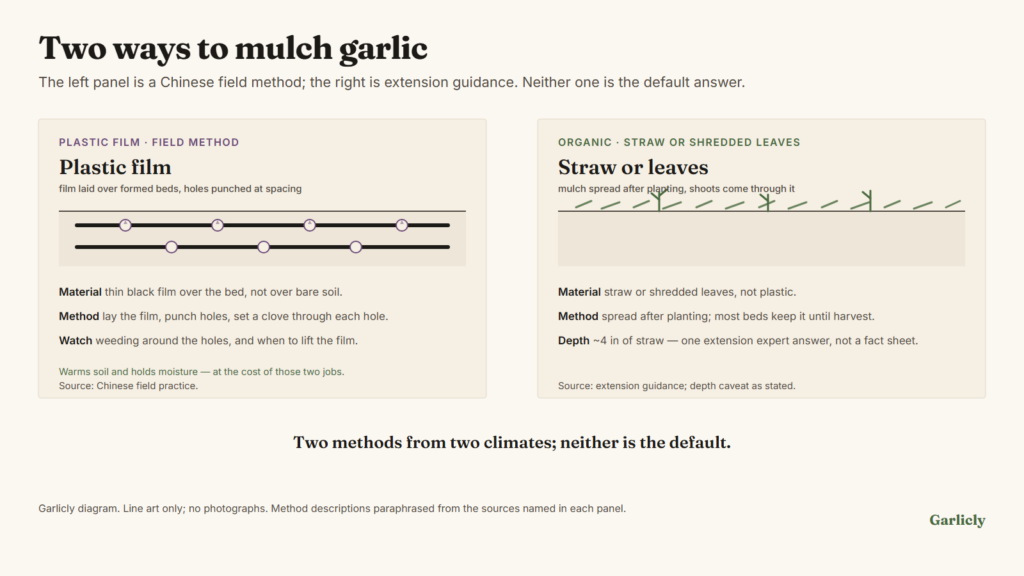
Plastic film is the Chinese field answer to a cold winter. The growers describe what it does: less evaporation, higher soil temperature, earlier regrowth in spring, fewer waterings, less soil crusting — but "it does not itself increase yield" 1, 2. It pays where winter is genuinely cold: in the northeast and northwest of China, where winter lows sit below −10 °C, it keeps the roots from freezing 1. In warm regions and in small home plots, the same growers often skip it 1, 2.
The one sourced detail about laying it is a timing rule: wait about three days after planting before covering the bed — film laid immediately after planting can make the soil too warm and stop the cloves from emerging 1.
Film has real costs, and the videos list them without much hedging:
- Overgrowth. Planted too early in a mild autumn, film pushes the seedlings past the safe leaf stage — six, seven, eight leaves — and those plants are the ones damaged by winter cold 2. The Chinese rule of thumb is that four to six leaves is the hardiest overwintering stage; at that stage the plants take −15 °C without dying 2.
- Protection stops at the soil line. Film protects the roots, not the top growth 1.
- Fertilizer discipline. With film, base fertilizer has to be right: too much burns the seedlings, too little leaves them deficient later 1.
- Rodents. One grower skips film where field mice are a problem — the warm space under the film becomes a nest, and the mice eat the seedlings 2.
A degradable film is also sold for garlic and onions; our material on it is a product demonstration only, with no performance data 3.
Organic mulch: straw and shredded leaves
The Maryland extension gives the practical version of the organic route: shredded leaves or straw spread along each side of the row keep weed seeds from germinating, and many gardeners apply it after planting and keep it through harvest 4.
On depth, there is exactly one figure we can attribute: an extension expert's answer on Ask Extension suggests about four inches of straw, or a chopped-leaf-and-straw mix, with a couple of extra inches in raised beds 5. That is a single expert answer to one grower's question — not a state extension fact sheet, and the Maryland guide gives no depth at all 4. Treat it as one experienced voice, not a general rule, and adjust to how cold and how wet your winter runs.
The only timing our sources give for organic mulch is "after planting"; anything more specific would be our invention, so we are not adding it.
Taking it off in spring
The Maryland guide gives the range of practice rather than a date: many gardeners keep the mulch through harvest, while others find that unmulched beds resume growth faster in spring and produce larger bulbs 4. That is a gardener's observation, not a trial result. If the mulch is holding cold and wet, pull it back; if the ground is drying and weeds are coming, leave it.
FAQ
Film or straw? They solve different problems. Film warms the soil and is worth it in genuinely cold field winters, but it demands the right planting date and fertilizer; straw and shredded leaves buffer the soil and suppress weeds without the plastic 1, 2, 4. Neither is a substitute for the other.
Straw or leaves? Either, and the extension answer actually combines them — straw with chopped oak leaves 5. Shredded leaves are the cheaper option if you have them.
Do I have to mulch at all? No. The Maryland guide notes that some growers leave beds unmulched and get faster spring growth and larger bulbs 4. Mulch is insurance against a harsh winter and a weed suppressor, not a requirement.
Next steps
- When to plant garlic in fall — the zone calendar, so the mulch goes on at the right time.
- The grow-garlic hub — the pillar page, from clove to bulb.
- How to plant garlic, step by step, and the depth-and-spacing comparison — companion guides, linked once they publish.
Sources
- 农民云飞V, 种大蒜为啥要覆膜?覆膜真的能增产吗?哪些情况不用盖地膜 (182 s, 2024-10-06): https://www.bilibili.com/video/BV1T71eYbE1b
- 菜农老彭, 大蒜还能种吗?种大蒜盖不盖地膜? (154 s, 2025-11-16): https://www.bilibili.com/video/BV16mCQBWE5j
- 春天的小雨呀, 大蒜洋葱专用可降解地膜 (57 s, 2025-10-18): https://www.bilibili.com/video/BV155WWzeEPY
- University of Maryland Extension, Growing Garlic in a Home Garden (updated 2023-08-22): https://extension.umd.edu/resource/growing-garlic-home-garden
- Ask Extension (eXtension, USDA-NIFA-funded), planting garlic in the fall #909677 (answered 2025-07-14): https://ask.extension.org/kb/faq.php?id=909677