On this page (20)
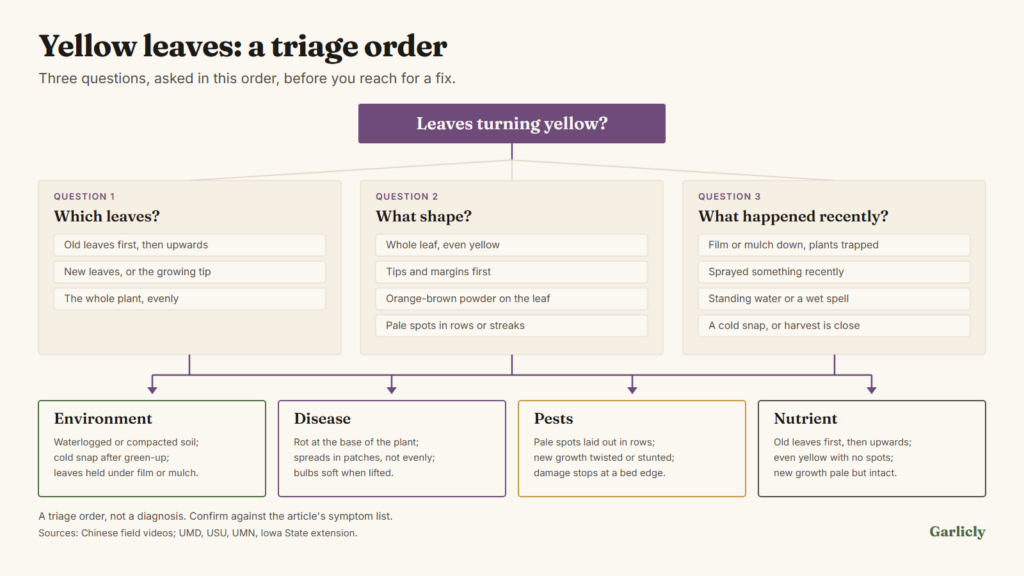
Yellow garlic leaves fall into four broad families — environment (heat under film, herbicide, waterlogging), disease (rust, root rots), pests (onion maggot, allium leafminer) and nutrient deficiency — and the fastest way to sort them is to check where the yellowing starts, what shape it takes, and what happened to the bed recently. Do not spray first; sort first. A field video on this exact problem puts it plainly: yellow leaves have several possible causes and each is managed differently, so identify before you treat 1.
Check these three things first
- Where on the plant is the yellow? Leaf tips only; whole plant pale; new leaves after a spray; lines of white dots; one side of the bed.
- What shape does it take? Uniform yellow; orange pustules; yellow streaks at the base of young leaves; scorched dry patches; wilting.
- What happened to the bed recently? Film laid and not released; herbicide sprayed; heavy rain or standing water; a hard freeze; the crop is headed toward harvest.
Keep those three answers in hand; the sections below are ordered to match them.
Environment first
Heat trapped under film
If you planted through plastic film and the seedlings were slow to be released, the leaves under the film can be scorched. The Chinese field video describes exactly that: hot, sunny weather, very high temperatures under the film, seedlings not released in time, leaves burned, "sunscald" 2.
What you see: yellowed, dry, scorched patches on the leaves that were under the film — not a uniform pale-green plant.
What to do: release the seedlings promptly, which the same video says both prevents further scorching and gets the plants growing; water dry fields to relieve the stress 2.
Herbicide injury
If the yellowing appears on new leaves after a herbicide was used — in the field or drifting in — suspect chemistry before biology. The same video lists herbicide injury as the second main cause of yellowing and dry tips in newly emerged garlic: a herbicide with poor crop safety plus hot weather, and the new leaves come out yellow with dried tips 2. Watering helps reduce the injury 2. We are not reproducing spray recipes here; the point is the pattern — uniform, new-growth yellowing after a chemical application.
Water: too little, or far too much
The four-cause Chinese video separates the two water problems neatly: dry soil produces yellow leaves, and rain or standing water which suffocates the roots produces yellow leaves as well — and if the field is holding water, drain it promptly 1. Maryland's garlic guide puts the same principle into the planting plan: garlic grows best in deep, well-drained soil and does poorly in clay or compacted ground 10. The full-process Chinese video also lists "environment too damp" among the conditions that bring disease on 11. So before you feed anything, check the soil: too dry and the tips go yellow; too wet and the roots rot.
Cold injury — with a caveat
Cold damage is real, and it is often seen alongside yellowing, but our sources do not treat frost as an independent cause of yellow leaves. Here is what they do say. Purdue's cold-weather guide, for garlic, describes thawed cloves as grayish-yellow and water-soaked 9. A Chinese recovery video describes a field hit by two cold waves: many leaves dried and died, badly hit plants kept only the heart leaf alive, and regrowth was slow 4. Iowa State, meanwhile, notes that garlic foliage can tolerate temperatures down into the 20s °F, and that yellow leaf tips are usually a sign of water stress, nutrient deficiency or disease 8.
So: if you had a hard freeze, expect leaf damage and slow regrowth; but do not assume the yellowing is "frost" and stop there — check water, nutrition and disease too. The recovery protocol in the Chinese video is a high-nitrogen, high-potassium top-dress with the green-up water in late February to early March 4; we have not translated its field rate here, because a rate copied without the field context is not a garden recommendation.
Disease
Rust
Rust is the disease with the most recognizable signature: it starts as chlorotic spots, then forms round or oval, slightly raised orange-yellow pustules on the leaf surface; the epidermis ruptures and releases yellow powder, with a yellow halo around the lesions. In a bad year the spots merge, the whole leaf yellows and the plant dies early; later in the season the same lesions produce dark brown-black telia 3. Minnesota's diagnostic page adds the same picture in fewer words: small bright orange spots, black spots developing at their edges, and leaves that wilt, turn yellow and dry out 6.
The weather that drives it is specific: the disease develops best at 10–23 °C with relative humidity above 85% (or leaves covered in water droplets), is suppressed above 24 °C, and is favoured by warm, humid spells in April–June and autumn; low-lying fields, poor drainage, dense planting and excess nitrogen all make it worse 3. That paragraph is single-source: those thresholds come from one video, and no other source in this article repeats them, so read them as that grower's account rather than an established epidemiological standard. Clean up crop debris, rotate where you can, plant on raised beds or deep furrows, avoid heavy nitrogen, and check the field for new hot spots after rainy spells 3. The video goes on to list fungicides; we are not reproducing that list — the diagnostic and cultural steps are the part that transfers.
Root rots and bulb rots
Yellowing that comes with wilting should send you to the roots. The four-cause video's rule is direct: pull a plant and look — if the roots are black and rotten, it is root rot 1. Minnesota's diagnostic pages give the different signatures: Fusarium basal rot turns leaves yellow to brown from the tip down and wilts them, with red-purple discoloration early and watery brown decay starting at the base; white rot yellows from the tip down too, but the bulb is soft and rotten from the base with white fluffy fungal growth and small black sclerotia; Botrytis neck rot yellows and kills the outer leaves first and leaves the neck water-soaked, and it is common in cool wet weather; pink root yellows the leaves with a reddish tinge from the tip down and leaves dark pink to maroon areas on the roots 5.
What transfers from that page: pull plants to check the base and roots, remove and destroy infected plants, rotate, and send a sample to a diagnostic lab if you need a name — this is not a problem to self-diagnose from a colour alone 5, 8. The Chinese video suggests a fungicide drench; we are not reproducing the recipe.
Two more to know
Minnesota's bulb page adds downy mildew — pale green to tan elongated spots, purplish-grey fuzzy growth, worst in cool wet weather — and onion yellow dwarf virus, which starts as yellow streaks at the base of young leaves, spreads to whole-leaf yellowing, and is carried by aphids 6. Both are reasons a lab diagnosis beats a guess.
Pests
Onion maggot
Onion maggot larvae feed on roots and bulbs, and the plant above responds by yellowing and wilting, sometimes quickly; the tell is holes in the bulbs and the maggots themselves 5. The Chinese four-cause video reaches the same symptom from the field side: insects chewing the roots make the seedlings yellow and wilt 1. Iowa State notes that rotation and disease-free sets are the general control for soil- and set-borne garlic problems 8. The video's prevention is a pre-planting seed treatment; we are not reproducing it.
Allium leafminer
Leafminers look different again: Maryland's guide describes rows of small white dots (egg-laying and feeding scars) on the middle to end of the leaf blades of garlic and other alliums, larvae mining inside the leaf, leaves curling or waving, and bulbs that end up smaller — plus the punctures and mines opening the plant up to bacterial and fungal pathogens 7. The management listed there is cultural: row cover over alliums before adults emerge (late February for spring), delaying fall planting by two weeks, removing allium debris after the season, and, for heavy infestations, cultivating the top two inches in early spring to disrupt the pupae 7. If you see white dots rather than yellow patches, this is the section you want.
Nutrient deficiency
Nitrogen
Nitrogen deficiency has a consistent signature across the sources: the leaf tips go yellow, the whole plant looks pale green to yellow, and the stems are thin 5. Iowa State adds a useful caution — many garlic cultivars are susceptible to yellow tips, it often shows before bulbing, and it is usually a sign of water stress, nutrient deficiency or disease rather than one single cause 8. So a pale bed is not automatically "hungry"; check the water and the roots first, then feed. The feeding schedule is the companion guide to this one.
Physiological yellowing (not a disease)
Two normal processes produce yellow leaves and neither needs a spray.
Mother-clove exhaustion. The Chinese four-cause video lists this first: at three to five leaves, the nutrients in the mother clove are used up and the seedling looks yellow — that is normal, and a foliar feed helps it recover 1. So if your plants are at that stage, otherwise healthy, and the yellowing is general rather than spotty, this may be all it is.
Maturity. As the crop finishes, lower leaves yellow and die back. Maryland's harvesting rule is to lift when about half the foliage has turned brown 10; Iowa State's is to harvest when the foliage begins to dry, at the stage with four to five dry lower leaves and only three to four green upper leaves left 8. Yellow leaves in the last weeks before harvest are the crop ending, not a disease starting.
What this page cannot tell you
- Frost as an independent cause of yellow leaves is not established by our sources — cold injury co-occurs with yellowing, but the diagnostic pages point to water, nutrition and disease first 8, 9.
- Which root rot you have cannot be settled from a photo or a colour; the extension pages themselves recommend a diagnostic lab 5.
- "No bolting" and other problems outside this page's scope are not covered here, because our material does not cover them.
FAQ
My garlic is yellow at three to five leaves — is it dying?
Probably not: that is the mother-clove exhaustion window in the Chinese field account, and it usually recovers with feeding 1. If the whole bed is pale and dry, check water first.
How do I tell rust from nitrogen deficiency?
Rust has discrete orange pustules with a yellow halo, and later black spots; nitrogen deficiency is a uniform tip-to-whole-plant yellow with thin stems 3, 5.
Should I pull a plant to check?
Yes, for any yellowing that comes with wilting — the roots and bulb base are the tell for the root rots and for maggot damage 1, 5.
Next steps
- When to plant garlic in fall — the zone calendar, so the crop starts at the right time.
- The grow-garlic hub — the pillar page, from clove to bulb.
- The feeding schedule, curing and storing, and mulching — companion guides, linked once they publish.
Sources
- 农民云飞V, 大蒜黄叶?先别乱打药,分清4种原因,对症管理 (59 s, 2026-10-11): https://www.bilibili.com/video/BV1hxp76ZEdA — four-cause framework: physiological, water/fertilizer, root rot, maggot.
- 睢阳农科, 大蒜刚出齐苗,就出现黄叶干尖,究竟是什么原因 (96 s, 2022-10-24): https://www.bilibili.com/video/BV1GG4y1h7Kf — film heat damage and herbicide injury.
- 河南科技小院, 大蒜锈病的症状与防治 (209 s, 2023-01-18): https://www.bilibili.com/video/BV1384y1h7BP — rust symptoms, conditions and cultural control.
- 睢阳农科, 年前发生冻害的大蒜,年后如何管理,才能获得高产 (98 s, 2023-03-03): https://www.bilibili.com/video/BV1D24y187Z3 — frost damage signs and recovery protocol.
- University of Minnesota Extension, What's wrong with my plant? — Garlic: Leaves yellow then wilt: https://apps.extension.umn.edu/garden/diagnose/plant/vegetable/garlic/leaveswilt.html
- University of Minnesota Extension, What's wrong with my plant? — Garlic: Undersized or no bulb developed: https://apps.extension.umn.edu/garden/diagnose/plant/vegetable/garlic/bulbdevelopment.html
- University of Maryland Extension, Leafminers on Vegetables (updated 2024-10-23): https://extension.umd.edu/resource/leafminers-vegetables
- Iowa State University Extension, Growing Garlic in the Home Garden (reviewed September 2026): https://yardandgarden.extension.iastate.edu/how-to/growing-garlic-home-garden
- Purdue Extension, HO-203: Effects of Cold Weather on Horticultural Plants in Indiana: https://ag.purdue.edu/department/hla/extension/extension-publications-library/ext-pubs/ho-203-w.html
- University of Maryland Extension, Growing Garlic in a Home Garden (updated 2023-08-22): https://extension.umd.edu/resource/growing-garlic-home-garden
- 蔬菜小白_beginner, 【大蒜种植教学】从种植到收获全流程… (1,181 s, 2025-11-23): https://www.bilibili.com/video/BV1cnU4BeEfo — disease list and "too damp" as a disease condition.