On this page (11)
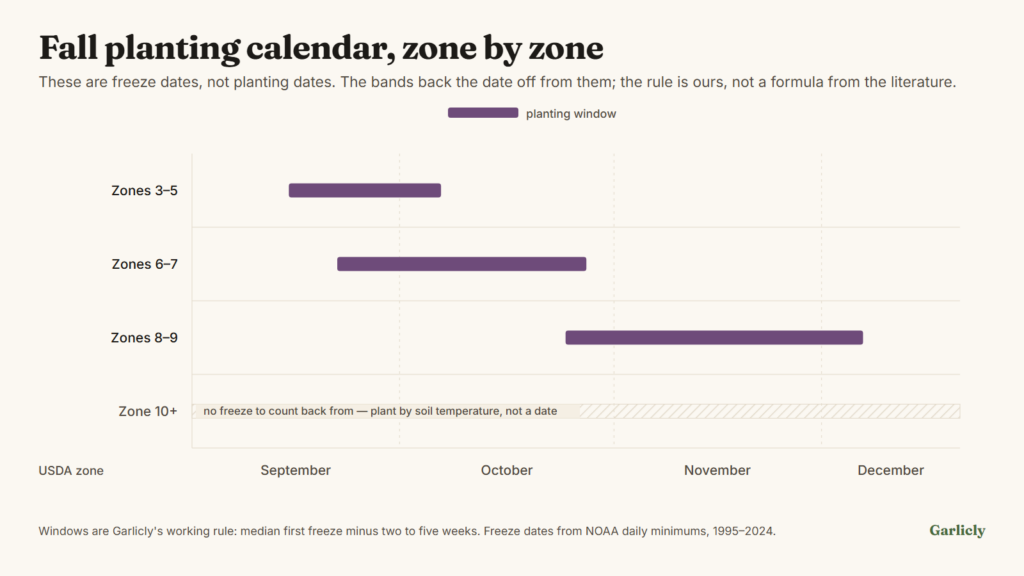
Plant garlic in fall two to five weeks before your first freeze — a working rule we have backed out of the freeze records below, not a published formula: mid-September to early October in zones 3–5, late September to late October in zones 6–7, and late October into early December in zones 8–9. For the Mid-Atlantic, the University of Maryland extension publishes a plainer version of the same advice: mid-to-late October 4. That is the short answer. Everything below is the freeze record behind each window, what the plant is doing in that time, and what goes wrong on either side of it.
There is a second convention in the extension literature, and it points the other way: Minnesota advises planting garlic "usually one or two weeks after the first killing frost" 8 — after, not before. Our reading of the difference is that the two windows are buying different protection. Ours buys rooting time, so the clove is established before the ground freezes; theirs accepts a shorter rooting window in exchange for less soft autumn growth to be caught out by a warm spell — the failure mode this page treats below. In most autumns the two overlap. When they do not, go by the plant rather than either calendar: a rooted clove showing one or two short leaves is where you want to be.
This autumn is running late. As of 7 November 2026, none of the five long-record airport stations behind our freeze table — Chicago, Washington, New York, Seattle and Atlanta — has recorded a 32 °F (0 °C) low yet; Chicago's coldest night so far is 36 °F, New York's is 43 °F 6. A late freeze does not move the calendar for you, but it does mean the window below is still open in more places than the month on the wall suggests — check your local forecast before you rely on this snapshot.
Affiliate links: we may earn a commission at no extra cost to you. Details.
Quick answer by zone
| Zone | Aim to plant | Median first freeze, anchor cities (1995–2024) | Notes |
|---|---|---|---|
| 3–5 | Mid-September to early October | Duluth, MN: Oct 1 · Minneapolis: Oct 17 · Chicago: Oct 29 | Short, cold season — the early end of the window matters more than the late end. |
| 6–7 | Late September to late October | Kansas City: Oct 26 · Boston: Nov 10 · Atlanta: Nov 17 · Washington, DC: Nov 19 · New York: Nov 25 | The Mid-Atlantic extension window is mid–late October. |
| 8–9 | Late October to early December | Seattle: Nov 14 · Dallas: Nov 27 · Houston: Dec 9 | Houston's first freeze fell after 31 December in 4 of 30 seasons. |
| 10+ | No freeze to count back from — plant by temperature | Phoenix and Miami: no regular frost | The two-month cold period garlic needs is what a zone 10 winter may not provide. |
How the table was built: we took the median first freeze at a representative city for each band, then backed the date off by two to five weeks for rooting and a few leaves — a working rule of ours, not a formula from the literature. The windows are ours; the freeze dates are computed from NOAA daily minimum temperatures, and where an extension service publishes its own window we cite it 4, 5, 6. Find your USDA zone by ZIP at the official map 7, then use the anchor city nearest you.
Why fall planting works
Garlic needs a cold period before it will bulb. The University of Maryland extension puts the requirement plainly: cloves must be exposed to 32–50 °F (0–10 °C) for about two months before bulb enlargement, which is triggered by long days — and that is why spring plantings produce smaller bulbs 4. Fall planting is how the crop gets that cold treatment without you doing anything to arrange it.
The plant is not idle over winter, either. Utah State University extension describes the sequence: during fall and winter the root system develops even though little top growth occurs, then tops grow rapidly the following spring, and large tops are what produce large bulbs 5. A clove planted in September has a root system and a starter leaf by the time the ground cools; a clove planted in April spends the same weeks trying to catch up.
Chinese field growers describe the same target from the other direction. Their window is the autumn equinox to Cold Dew — late September to mid-October — at 18–22 °C (64–72 °F), and the seedling they want going into winter is "four leaves and one heart": four expanded leaves with the next one still rolled inside 1. That is the growth stage that overwinters best, and it is a better thing to aim at than a date on a calendar, because it looks the same in every climate. Two other growers give the same window in practice: a Yangtze-valley gardener starts as soon as October arrives 2, and a field grower filmed on 22 September said bulb garlic should go in around National Day, 1 October 3.
Zone-by-zone calendar
The dates below are medians, not promises. The "middle half" range is the interquartile range of the 30 seasons — the years when you are neither lucky nor unlucky. Recent seasons are shown because they show how far a single year can drift.
Zones 3–5
Aim for mid-September to early October, and lean early if you are far north.
- Duluth, MN: median Oct 1 (middle half Sep 24 – Oct 9; 2023 Oct 16, 2024 Oct 14, 2025 Oct 7) 6. Short season: plant mid-September and let the roots do the work — do not expect a lot of top growth.
- Minneapolis: median Oct 17 (middle half Oct 7–24; 2023 Oct 27, 2024 Nov 1, 2025 Oct 24) 6. Late September to early October.
- Chicago: median Oct 29 (middle half Oct 11 – Nov 2; 2023 Oct 30, 2024 Nov 20, 2025 Nov 9) 6. Early-to-mid October is the safe middle; 2024 shows how late the freeze can run.
If you are in this band and the month has turned, you are not necessarily out of time — but the plant you get is the plant that overwintered, and a late clove has less root system when growth stops.
Zones 6–7
Aim for late September to late October.
- Kansas City: median Oct 26 (middle half Oct 15–31; 2023 Oct 28, 2024 Oct 16, 2025 Nov 1) 6.
- Boston: median Nov 10 (middle half Nov 6–15; 2023 Nov 12, 2024 Nov 13, 2025 Nov 20) 6.
- Atlanta: median Nov 17 (middle half Nov 11–26; 2023 Nov 29, 2024 Nov 30, 2025 Nov 11) 6.
- Washington, DC: median Nov 19 (middle half Nov 13–27; 2023 Nov 28, 2024 Nov 30, 2025 Nov 11) 6.
- New York: median Nov 25 (middle half Nov 16 – Dec 7; 2023 Nov 25, 2024 Nov 30, 2025 Dec 4) 6.
For the Mid-Atlantic specifically, the University of Maryland extension gives its own instruction: plant individual cloves mid-to-late October, so they can grow roots and a few leaves before cold weather 4. That sits inside the band above and is the one window here that comes straight from an extension service rather than from our arithmetic.
Two seasonal notes. Washington's 2023 and 2024 freezes landed on 28 and 30 November, a week to ten days after its median, and New York's 2025 freeze landed on 4 December — the last two autumns ran late 6. Treat any single published date, including ours, as the middle of a range.
Zones 8–9
Aim for late October into early December; the warmest parts of this band can plant into November and still be fine.
- Seattle: median Nov 14 (middle half Nov 3–29; 2023 Oct 29, 2024 Nov 28, 2025 Nov 30) 6. 2023 shows the early side: a late-October freeze arrived two weeks before the median.
- Dallas: median Nov 27 (middle half Nov 15 – Dec 6; 2023 Nov 27, 2024 Dec 6, 2025 Dec 2) 6.
- Houston: median Dec 9 (middle half Nov 27 – Dec 17) 6. But check the qualifier: in 4 of the 30 seasons, the first freeze came after 31 December — 2023 and 2024 both did. Houston is a place where "wait for the freeze" is bad advice; plant in November and use the temperature band below instead.
- Phoenix: no regular frost. In 27 of 30 years, daily lows never reached 32 °F between 1 September and 31 December; the three years that did recorded it in late December 6.
Zone 10+
There is no freeze to count back from — Phoenix never reached 32 °F in 27 of 30 autumns, and Miami never did at all in the same 30 years 6. Without a freeze date, plant by the temperature band: when the summer heat breaks and the soil has cooled out of its summer range. Expect the cool window to be short, and expect bulbs to stay smaller, because the crop's two-month cold requirement 4 is exactly what a zone 10 winter may not supply. That is a limit of the crop, not of your planting date.
Soil temperature is the real signal
The freeze date is a planning tool; the plant responds to soil temperature and day length. If you own a soil thermometer, this is the one measurement worth taking: probe at clove depth (about 5–8 cm / 2–3 in) in the bed you intend to use.
If you do not own one yet, Taylor soil thermometer for seed germination and planting reads the bed directly instead of leaving you to guess from the air temperature.
A stainless-stem alternative if you want something sturdier: Smart Choice stainless steel soil thermometer.
The Chinese growers in our source work from an 18–22 °C (64–72 °F) band, which is the range where the young plant emerges and grows without racing 1. Their video does not specify whether that number is air or soil temperature, and we are not going to pin it to one — treat it as the general growing-season band, and use the soil reading as your tiebreaker. When the soil is still warm, cloves root fast and tops push too far; when it is already cold, they sit and do little.
If you do not have a thermometer, the growth-stage check does the same job: the clove is on schedule when it has four expanded leaves and a fifth still rolled inside at the point growth stops 1. Once you know how deep and how far apart to plant (the article linked at the end covers both), the date question mostly answers itself.
What happens if you plant too early or too late
Both mistakes cost you, in different ways, and the Chinese source is unusually specific about the mechanisms 1.
Too early. Warm autumn soil rots the mother clove — root rot, dead seedlings, and a rise in soil-dwelling pests 1. The surviving plants also run ahead of the season: a fat, over-vigorous top going into winter is the one damaged by the freeze or by a late cold snap, and that is where the yield goes 1.
Too late. The plant is still small when the ground seals, its roots are weak, and its cold tolerance has not been built up yet 1.
Can I still plant in December?
It depends on the ground, not the calendar. In zones 8–9 the first freeze often lands in late November or December (Dallas Nov 27, Houston Dec 9) 6, so a December planting in a mild year can still root before the coldest stretch — though the plant will be small. In zones 3–6 the median freeze has already passed by then, and a clove in frozen ground does nothing until spring. If you are late, plant anyway and expect a smaller bulb; the alternative is not planting at all.
What if my garlic sprouts before winter?
A sprout is not a failure by itself. The problem the source describes is a plant that has run too far ahead — the over-grown one is what gets damaged 1. If yours has broken the surface in October, leave it and mulch the bed for winter protection (mulching after planting is standard practice in the Maryland extension guide 4); if it has run well past the four-leaf stage before the cold sets in, the fix is next year's date, not anything you do now.
Next steps
- How deep and how far apart to plant — the companion article, with the US and Chinese numbers side by side.
- The grow-garlic hub — the full pillar page, from clove to bulb.
- Planting day, step by step — splitting, furrow, clove orientation, watering.
- Mulch after planting — what to put over the bed and when.
As an Amazon Associate, Garlicly earns from qualifying purchases.
Sources
- 小何说农业, 大蒜的最佳种植时间您知道吗 (190 s, 2023-09-14): https://www.bilibili.com/video/BV12z4y1u7x6 — timestamps refer to the subtitle track. The track's last 30 seconds are instrumental noise with no speech.
- 小林种植记, 进入10月份长江流域华北地区大蒜可以种起来了… (238 s, 2026-10-07): https://www.bilibili.com/video/BV1iLHC6qE5A — a Yangtze-valley grower demonstrating the October planting routine; cited for the October start, not for US dates.
- 种地老夏, 大蒜什么时候种?大蒜怎么种? (230 s, 2025-09-22): https://www.bilibili.com/video/BV19Sncz8ELQ — filmed 22 September; says bulb garlic should go in around National Day (1 October) in eastern China.
- University of Maryland Extension, Growing Garlic in a Home Garden (updated 2023-08-22): https://extension.umd.edu/resource/growing-garlic-home-garden
- Utah State University Extension, How to Grow Garlic in Your Garden (published 2020-05): https://extension.usu.edu/yardandgarden/research/garlic-in-the-garden
- NOAA RCC-ACIS daily minimum temperature data, queried 2026-11-07 — first day on or after 1 September with a daily low at or below 32 °F (0 °C), per station, 1995–2024 seasons; medians and middle-half ranges computed by this site from the daily series. Data service: https://data.rcc-acis.org/
- USDA Plant Hardiness Zone Map (official, ZIP lookup): https://planthardiness.ars.usda.gov/
- University of Minnesota Extension, Growing garlic in home gardens: https://extension.umn.edu/garden-and-home/yard-and-garden/gardening-in-minnesota/growing-garlic — plant cloves "usually one or two weeks after the first killing frost."