On this page (8)
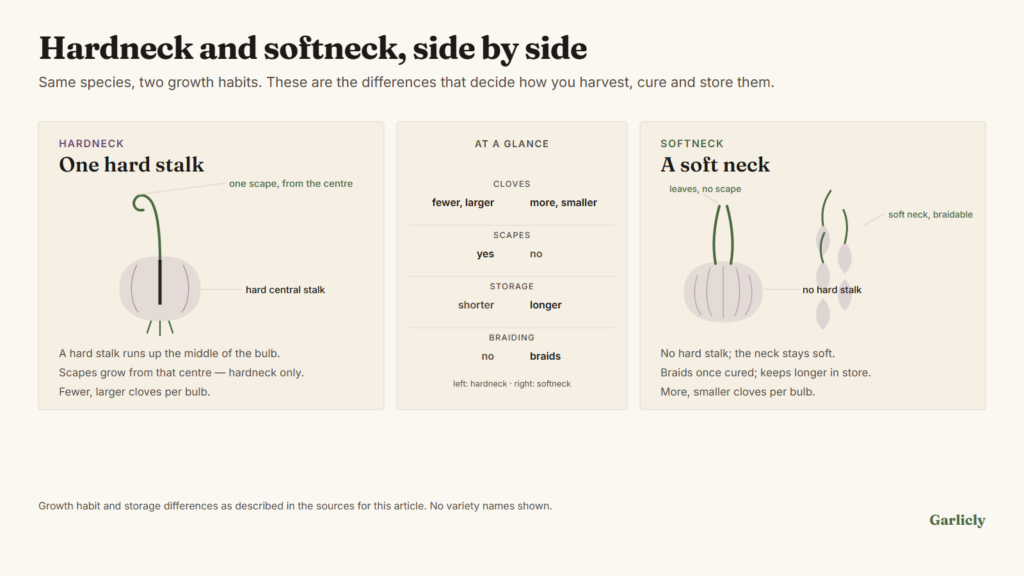
Hardneck garlic grows a stiff central stem and a scape, carries larger cloves, and stores for a shorter time; softneck garlic has a pliable neck, smaller cloves, a longer storage life, and is the type usually sold in grocery stores. Both types need a cold spell before they bulb, so the choice comes down to your winter, your storage, and whether you want scapes 1, 2.
The two types, side by side
| Hardneck | Softneck | |
|---|---|---|
| Stem | Stiff central stem running up through the bulb; produces a scape (flower stem) 1, 2 | Pliable neck, no scape; the type preferred for braiding 2 |
| Scape | Yes — pinched out to increase bulb size, and eaten like scallions 1 | No |
| Cloves | Larger cloves; Maryland's seed-size guide describes large hardneck bulbs at 6–7 cloves each 1 | Smaller cloves 1 |
| Storage | Shorter storage life 2 | Long storage life 1; stores very well 2 |
| In the grocery store | Less common | The type typically sold in grocery stores 1 |
| Why you might pick it | You want scapes and don't need months of storage | You want the longest shelf life, and you want to braid |
| Beginner-friendly | — | A longer storage life leaves more margin after harvest 1 |
That last row is not a source's phrase: no guide we have names a "beginner type". It is a reasonable reading of the storage difference, not a rule.
What "hardneck" and "softneck" actually mean
The names describe the stem. Hardneck types send a long, stiff stem up through the bulb, and most of them throw a scape — the flower stem Maryland's guide says to pinch out so the plant puts its energy into the bulb 1; Utah's guide notes the same long stem and a shorter storage life 2. Softneck types have a pliable neck instead, no scape, and the combination of soft neck plus good storage is why they are the ones braided and sold in stores 1, 2.
One variety name is worth knowing because it appears everywhere: Rocambole is a hardneck — a well-known variety within the hardneck group. We are not going further into variety names in this article; the sources we can cite describe the two types, not a catalogue.
Why Chinese sources split it differently
Open a Chinese garlic video and you will meet a different classification: purple-skinned versus white-skinned garlic, many-clove versus few-clove bulbs, cold-response groups — sensitive, dull, and intermediate — plus early, mid and late maturity 3. Note what this is: one video's classification, offered as an example of the axes Chinese growers use rather than a codified standard. Chinese variety guidance then lists local cultivars by province and yield 7.
That is not a translation of hardneck/softneck. It is a different set of axes:
- Skin colour is a colour trait, not a neck type. The two systems describe different things, and one does not translate into the other.
- Clove number and maturity are counted differently — "many cloves" in the Chinese system is a bulb trait, not the same distinction as "hardneck".
- Cold response is its own axis — Chinese breeders group varieties by how they react to low temperature, which is not the same question as whether the stem is stiff 3.
So when you read Chinese growing material — and the Chinese field videos on this site are full of it — do not map 紫皮/白皮 onto hardneck/softneck. Ask what trait the speaker is actually describing before you convert it into a Western category. That is the whole point of this section: the two vocabularies are both useful, and they do not line up one-to-one.
Choosing between them
Three questions do most of the work:
- Do you want scapes? Only hardneck gives them 1. If you want garlic scapes for the kitchen, the choice is made.
- How long do you need it to keep? Softneck stores longer 1, 2. If you grow a year's supply and eat it slowly, that difference matters.
- Will you braid it? Braiding is the softneck trick 2.
On winter hardiness, our sources describe both types as hardy and needing cold, and they do not rank the two against each other — so neither will we. Both types need a real cold spell to bulb: Maryland puts it at 32–50 °F for about two months 1, and the RHS guide states the general rule that garlic usually needs a spell of cold to form a good bulb 6. Which type does better in your particular winter is a question for a local grower or supplier, not for a page that has never seen your weather.
Seed garlic: what you are actually buying
Garlic is grown from cloves, not from true seed. True seed does exist — a Chinese gardener in our material let a scape flower and harvested the tiny seeds, which look like miniature cloves, but the plants from them grow slowly and the cloves are the practical route 4.
Buy certified, disease-free seed garlic from a reputable seed source, and do not plant grocery-store bulbs, which may carry disease without showing it 1. A grower in our material bought seed garlic online, then sun-dried or soaked it for a day before planting to break dormancy and speed emergence 5. If you save your own, Utah's guide keeps the largest, healthiest bulbs back as planting stock 2.
For the named cultivars behind each type — the seven our sources document, and what each one is recommended for — see Best garlic varieties to grow.
FAQ
Can you braid hardneck garlic?
Braiding is the softneck method; hardneck's stiff stem is the whole reason it is called hardneck 1, 2.
Is grocery-store garlic softneck?
Typically, yes 1. That is also why it keeps so well on a shelf.
Do both types need cold?
Yes. Both are described as hardy crops that need a cold period to bulb 1, 6.
Does garlic grow from seed?
True seed exists — the tiny seeds that form after a scape flowers — but it is slow and the cloves are the practical route 4.
Next steps
- When to plant garlic in fall — the zone calendar, so you plant the right type at the right time.
- The grow-garlic hub — the pillar page, from clove to bulb.
- How to plant garlic step by step, curing and storing, and mulching — companion guides, linked once they publish.
Sources
- University of Maryland Extension, Growing Garlic in a Home Garden (updated 2023-08-22): https://extension.umd.edu/resource/growing-garlic-home-garden
- Utah State University Extension, How to Grow Garlic in Your Garden (published 2020-05): https://extension.usu.edu/yardandgarden/research/garlic-in-the-garden
- 大蒜有哪些品种类型? (91 s): https://www.bilibili.com/video/BV1HN4y1N7Ht — subtitle status weak; cited lines checked against the track.
- 简约AA, 大蒜种子长什么样?用大蒜种子种大蒜 (159 s, 2021-07-20): https://www.bilibili.com/video/BV1WD4y1o7sX — true seed vs cloves.
- 风信子的田园小院生活, 又到了可以种大蒜的季节 每年都用这种方法 种的大蒜出苗快又齐 (272 s): https://www.bilibili.com/video/BV18GtRehEu4 — buying seed garlic, breaking dormancy.
- RHS, How to Grow Garlic: https://www.rhs.org.uk/vegetables/garlic/grow-your-own
- 睢阳农科, 这几个大蒜品种,在我国种植面积大产量高,都是各地主推品种 (134 s): https://www.bilibili.com/video/BV1zg411D78T — Chinese local cultivars by province and yield.