On this page (11)
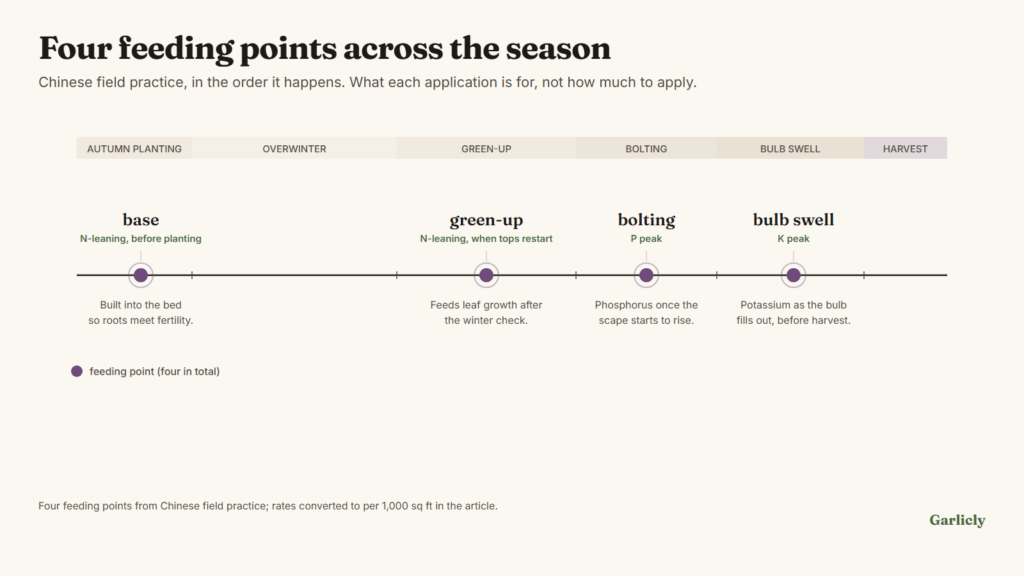
Fertilize garlic at four points — a base dressing before planting, a green-up top-dress as spring growth starts, a phosphorus-leaning feed at bolting, and a potassium push as the bulbs swell — and treat foliar sprays as a supplement, not the main course. The schedule below is built from Chinese field videos, which give rates per 亩 (mu); we convert those to square feet before you use any of it, and then set the lower-input US extension schedule beside it.
Affiliate links: we may earn a commission at no extra cost to you. Details.
First, the units — and the intensity gap
Two conversions to hold in your head:
- 1 亩 (mu) ≈ 667 m² ≈ 1/6 acre ≈ 7,175 sq ft.
- 1,000 sq ft ≈ 0.14 亩, and 1 斤 = 0.5 kg.
Those conversions matter because Chinese field rates assume intensive production — beds, film, flush irrigation, high inputs. A US backyard bed is a lower-input system, so the converted numbers below are the intensive end of the range, not the default for a raised bed. The extension schedule at the end is the low-input reference.
| Chinese rate | ≈ per 1,000 sq ft (derived) |
|---|---|
| 5 kg/亩 | 0.7 kg (1.5 lb) |
| 3 kg/亩 | 0.42 kg (0.9 lb) |
| 2 kg/亩 | 280 g (0.6 lb) |
| 15 kg/亩 | 2.1 kg (4.6 lb) |
| 20 kg/亩 | 2.8 kg (6.1 lb) |
| 25 kg/亩 | 3.5 kg (7.7 lb) |
| 50 g/亩 | 7 g |
| 150 g/亩 | 21 g |
The conversions are ours: 1,000 ÷ 7,175 = 0.139, multiplied by the Chinese rate. They are rounded approximations, not exact equivalents.
1. Base dressing, at planting
The extension guides put a complete fertilizer down before planting, worked into the bed 9, 10 — that is the foundation the rest of the season sits on. The Chinese videos in this article start their clock at green-up, so there is no field rate here; use the extension base rate.
2. Green-up: the first spring feed
The Chinese source is specific about why plain urea is not the answer at green-up: growth needs nitrogen, but phosphorus demand peaks at bolting and potassium demand peaks from bolting into bulb swell — and urea itself has to convert in the soil (this account says about four to five days) before the roots can take it up, which is slower in a cold spring 1. The recommendation is a compound NPK fertilizer, calcium ammonium nitrate, or a microbial product rather than urea alone 1.
For a garden bed, a balanced water-soluble NPK is the simplest way to hit that green-up target: a water-soluble NPK for spring green-up.
Timing: the first green-up watering comes after the spring equinox and before Qingming, when the daily mean is around 7 °C; the field rate is 40 斤 (20 kg) of compound fertilizer per 亩, or 50 斤 (25 kg) of calcium ammonium nitrate, or about 10 kg of a microbial agent 1.
If the plants come out of winter yellow and weak, a second video uses urea at 5 kg/亩 plus potassium dihydrogen phosphate at 3 kg/亩, flushed with the irrigation water; for normal-looking plants, a soluble NPK at 10–15 kg/亩 2. Converted: 0.7 kg urea and 0.42 kg KH₂PO₄ per 1,000 sq ft, or 1.4–2.1 kg of soluble NPK.
3. Bolting: phosphorus peaks
At bolting, phosphorus demand is at its peak, and potassium demand runs from bolting into bulb swell 1. The field method is "feed the roots, supplement the leaves": a high-potassium fertilizer at the root zone plus potassium dihydrogen phosphate sprayed on the canopy, with the potassium credited for moving photosynthate into the bulb 4.
The foliar rate at bolting is 150 g/亩 of potassium dihydrogen phosphate in 15 kg of water, sprayed evenly — and again before bulb swell 3. Converted, that is about 21 g per 1,000 sq ft, at a spray concentration of 1%.
4. Bulb swell: the potassium push
When the bulbs start to swell in early May, the field rate is a high-nitrogen, high-potassium fertilizer at about 30 斤 (15 kg) per 亩, or a tank mix of potassium dihydrogen phosphate at 2 kg/亩 plus urea at 5 kg/亩, dissolved fully and flushed with the water 1. Converted: 2.1 kg per 1,000 sq ft for the first, or 280 g KH₂PO₄ plus 0.7 kg urea for the second.
5. Foliar feeding: the supplement
Foliar feeding is not a replacement for the soil feeds; it is for the moments when root uptake lags. The clearest window in the videos is the three-leaf stage, just as the seedling moves off the mother clove and its roots are still shallow: per 亩, 100 ml of a 42% high-nitrogen fertilizer plus 100 g of 99% potassium dihydrogen phosphate in 20 kg of water, sprayed evenly 5. If you scale it, keep the ratio — 100 ml : 100 g : 20 kg.
Before winter, at five or six leaves, another video sprays 50 g/亩 of potassium dihydrogen phosphate in 15 kg of water, aimed at root growth and cold hardiness 3. We list only the fertilizer ingredients; the videos also add growth regulators, which are not fertilizer and are not covered here.
Watering that goes with the feed
- After planting: soak the planting furrow through once, and water again three to five days later — uneven watering is the main reason the video gives for patchy emergence 8.
- Before winter: the antifreeze watering should be late rather than early — wait until the five-day average temperature is below about 5 °C, when the plants have gone dormant 6.
- The winter-water question: a field already watered before the film went on does not need a winter watering — extra water lowers soil temperature, dulls the film's light transmission, can spread rot bacteria, and leaches fertilizer. A field that shows fertilizer burn does need water, and generously 7.
The US extension schedule, for comparison
This is the lower-input counterpart to the field calendar:
- Maryland: fertilize before planting in fall, again in April, and if needed in late May 9.
- Utah: side-dress ½ lb of 21-0-0 per 100 sq ft in mid-April, and ¼ lb in late May 10.
- Minnesota: top-dress as shoots emerge, then again two to three weeks later; avoid nitrogen after the first week of May, and stop watering two weeks before harvest 11.
Same crop, same stages, roughly — but fewer applications and smaller amounts per area. That is the difference between a field calendar and a garden one.
FAQ
Can I use urea alone at green-up?
The Chinese source argues against it: nitrogen is part of the answer, but phosphorus and potassium are timing-specific, and urea needs days in cold soil before it converts 1.
How big is a 亩?
About 667 m², roughly one-sixth of an acre, or about 7,175 sq ft — so 1,000 sq ft is about 0.14 亩.
Do I need foliar feeding at all?
It is a supplement for when root uptake lags — at the three-leaf stage, or before winter 5, 3; the soil feeds are the main course.
Next steps
- When to plant garlic in fall — the zone calendar, so the base dressing goes down at the right time.
- The grow-garlic hub — the pillar page, from clove to bulb.
- How to plant garlic step by step, curing and storing, and mulching — companion guides, linked once they publish.
As an Amazon Associate, Garlicly earns from qualifying purchases.
Sources
- 康达农资, 年后大蒜返青肥,尿素,复合肥,硝酸铵,用那个好 (135 s, 2024-01-03): https://www.bilibili.com/video/BV1qC4y1i7fz — green-up feed, NPK demand by stage, field rates.
- 三农木雨听风, 给大蒜追肥,选择复合肥还是尿素? (83 s, 2025-10-26): https://www.bilibili.com/video/BV1QVszzVEUn — yellow/weak stand rate vs normal stand rate.
- 睢阳农科, 大蒜要想获得高产,用对磷酸二氢钾很关键 (141 s, 2022-11-16): https://www.bilibili.com/video/BV18P411g78v — potassium dihydrogen phosphate windows and rates.
- 农人-阮方兵, 大蒜抽苔期怎么追肥? 蒜头才能结的大? (213 s, 2025-04-16): https://www.bilibili.com/video/BV16QoTY6ECb — bolting-stage high-K feed, root plus foliar.
- 睢阳农科, 大蒜叶面肥,这个时间喷施,防黄叶干尖产量高 (87 s, 2024-10-15): https://www.bilibili.com/video/BV1q22ZYSE4s — three-leaf-stage foliar recipe.
- 爱华生活记, 大蒜越冬前,浇封冻水有什么用?什么时间浇最好?4个作用很重要 (317 s, 2023-02-16): https://www.bilibili.com/video/BV1n24y1p7Aj — antifreeze watering timing.
- 农业技术分享2022, 大蒜要不要浇越冬水? (142 s, 2022-10-27): https://www.bilibili.com/video/BV1gg411h7xS — when winter water is unnecessary, when it is needed.
- 农民云飞V, 大蒜啥时候可以浇水?大蒜为啥会出苗不齐? (173 s, 2024-10-02): https://www.bilibili.com/video/BV1wz4uepEw2 — after-planting watering rhythm.
- University of Maryland Extension, Growing Garlic in a Home Garden (updated 2023-08-22): https://extension.umd.edu/resource/growing-garlic-home-garden
- Utah State University Extension, How to Grow Garlic in Your Garden (published 2020-05): https://extension.usu.edu/yardandgarden/research/garlic-in-the-garden
- University of Minnesota Extension, Growing garlic in home gardens (reviewed 2026): https://extension.umn.edu/garden-and-home/yard-and-garden/gardening-in-minnesota/growing-garlic