On this page (10)
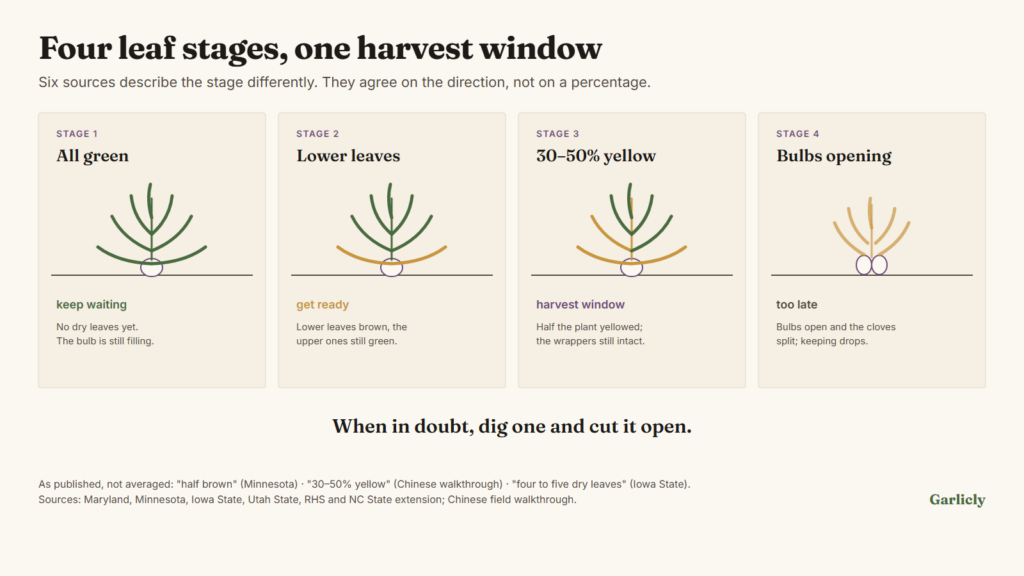
Harvest garlic when the lower leaves have died back and roughly half the plant is still green — and cut one bulb open before you lift the row. In most home gardens that lands between late June and late July, but the leaves decide it, not the calendar: lift too early and you get small bulbs; wait too long and the bulbs split apart and keep badly.
This page is only about that decision: the signals, the checks that settle it, what each kind of mistake costs, and how to lift the plants on the day. What happens afterwards — curing, trimming, storage — belongs to our curing and storage guide, and is dealt with there in one paragraph at the end.
The sources are one Chinese field walkthrough and five English guides: Maryland, Minnesota, Iowa State, Utah State, the RHS, and NC State. They do not agree on the exact proportion of yellow leaves you should be looking for. That disagreement is the most useful thing on this page, because it tells you where a percentage stops being a measurement and becomes a rough habit.
Six sets of signals, one direction
| Source | The signal it gives |
|---|---|
| Maryland | Lift when about half the foliage has turned brown; bulbs should be "full-sized and well-wrapped." Their central Maryland date is around 1 July, varying by cultivar and season. |
| Minnesota | Start when the lower leaves brown and half or slightly more of the upper leaves are still green. Late June to late July there. |
| Iowa State | The ideal stage is four to five dry lower leaves and only three to four green upper leaves. July or August in Iowa. |
| Utah State | Tops yellow but not yet dry. |
| RHS | Leaves turned yellow; don't delay beyond that, because late-lifted bulbs open up and store for less time. |
| Chinese walkthrough 1 | 30 to 50 percent of the leaves yellowed is the best window. |
Read the column and the disagreement is obvious: "half brown," "30 to 50 percent yellow," "four to five dry leaves." These are three different ways of saying a similar thing, and none of them is precise enough to be worth averaging. What every source agrees on is the direction — yellowing starts at the bottom, and you lift while a real share of the upper plant is still green.
That is the honest version of the rule: the leaf count gets you to the right week, and something else has to settle the day.
The checks that beat a percentage
Cut one bulb open. Minnesota's test is the best one in the set: pull a bulb, cut it in half, and look at the cloves against the skins. If the cloves fill the skins, the plant is ready; if there is space between the cloves and the wrapper, it is not. This one check replaces every percentage on this page.
Dig one and look at the whole bulb. Maryland describes the target as full-sized and well-wrapped; NC State takes the same idea a step further and suggests lifting one plant to check, then replanting it if it is not ready. Garlic tolerates that; a single plant lifted and put back is a cheap price for not lifting the row on the wrong day.
Count the leaves, if you like counting. Iowa State's ratio — four to five dry lower leaves, three to four green upper leaves — is the most specific version in our set, and it matches what the others describe less exactly.
One more habit, and this one is not from the sources: growers squeeze a bulb and judge by feel, a ready bulb being firm all the way up. None of our sources states it, so treat it as a field habit rather than a test.
If you only remember one action, remember the first one: dig a bulb and cut it open. The percentage in the table tells you which week to walk out with a knife; the cut bulb tells you whether to lift the row.
If you lift too early
Our sources give exactly one consequence here, and it comes from Minnesota: harvesting too early results in small bulbs 3.
That is it. There is no sourced statement in our set about early-lifted garlic storing badly, spoiling, or failing to cure, and we are not going to supply one by inference — the more so because a bulb lifted early is still intact, just undersized. If you suspect you are early, the checks above are the way to find out before the row is up: an undersized bulb with space between cloves and wrapper is your answer.
If you lift too late
Here the sources are emphatic, and they agree on the mechanism: past a point, the bulb starts to come apart.
- Minnesota: cloves pop out of the bulbs 3.
- Utah State: "Over mature bulbs are open and do not store well" 5.
- RHS: late-lifted bulbs "tend to open up and have a shorter storage life" 6.
- The Chinese walkthrough: too late gives bulbs of uneven size, and even rot; once the leaves yellow the bulbs are still growing, but if harvest runs into the rainy season the bulbs can rot or the cloves split apart and quality drops 1.
Note what the Chinese source adds that the others do not: weather during the delay. Their harvest window runs into a wet season, so lateness there means rot as well as split bulbs 1. That is their climate, and worth knowing if yours has a wet stretch in early summer — but it is an observation from one growing region, not a rule that applies everywhere.
The pattern across all four is structural rather than cosmetic. Late garlic does not merely look worse; the wrappers that protect the bulb open, and the cloves separate. Those are the wrappers that decide how long the bulb keeps.
Harvest day
The Chinese walkthrough is the most specific on the day itself: harvest on the last day of a run of sunny days, not in rain or immediately after it, because wet harvesting damages bulb quality 1. NC State says the same in fewer words — pick a dry day, and one when the plants have not just been watered 7.
On lifting, the sources split between pulling and digging, and both are described. The Chinese grower grabs the stem close to the bulb, guards the bulb itself, and pulls in one motion, cutting the roots immediately after 1. The extension guides all prefer a fork or spade, and the RHS adds the reason to be careful with either method: bruising shortens storage life 6. In loose soil a straight pull works; in heavier soil, loosen first.
One preparatory step belongs here rather than in the storage article: ease off the water as harvest approaches. Maryland waters less frequently near harvest to avoid disease 2; Minnesota stops watering two weeks before harvest, to keep the wrappers from staining and to reduce disease 3; Iowa State stops irrigating in late July so the foliage can die down, which also limits disease spread and staining 4. Three states, one instruction.
The calendar moves, the signal doesn't
The same leaf signal produces very different dates: around 1 July in central Maryland 2, late June to late July in Minnesota 3, July or August in Iowa 4, late spring to early summer in the RHS's British climate 6, and May to June for the Chinese growers 1. Warmth moves the date by weeks, and the plants tell you where you are.
Which is why the useful thing to carry into the garden is the check, not the month. If you are still deciding when to plant the crop in the first place, the zone calendar handles that end of the season.
What happens next
Lift on a dry day, keep the tops on, and get the plants out of direct sun into a warm, airy place to dry — Maryland dries them on screens in a carport or porch for 7 to 14 days and then cuts the tops off, while Utah State gives one to two weeks in a shady warm spot. That is as far as this page goes: the curing temperatures, humidity, containers, and shelf life are all in the curing and storage guide.
FAQ
Can I harvest as soon as a few leaves yellow?
No — the lower leaves need to have died back, with roughly half the upper plant still green. A few yellow tips early in the season are a different problem, not a harvest signal.
What if I'm a week late?
Cut one open. If the cloves are still held inside intact wrappers, the bulb is fine to cure as normal; if the wrappers have opened and the cloves are separating, eat those first, because they will not keep.
Does rain matter?
Yes. Harvest on a dry day, ideally the last of a sunny run, and not straight after rain 1, 7.
Should I stop watering first?
All three extension guides ease off before harvest — Maryland cuts frequency, Minnesota stops two weeks out, Iowa State stops irrigating in late July 2, 3, 4.
Next steps
- When to plant garlic in fall — the other end of the season, by zone.
- The grow-garlic hub — the whole cycle from clove to bulb.
Sources
- 蔬菜小白_beginner, 【大蒜种植教学】从种植到收获全流程|浇水施肥、摘芽、病虫害、保存一次讲清楚! (1181 s, 2025-11-23): https://www.bilibili.com/video/BV1cnU4BeEfo
- University of Maryland Extension, Growing Garlic in a Home Garden (updated 2023-08-22): https://extension.umd.edu/resource/growing-garlic-home-garden
- University of Minnesota Extension, Growing garlic in home gardens: https://extension.umn.edu/garden-and-home/yard-and-garden/gardening-in-minnesota/growing-garlic
- Iowa State University Extension and Outreach, Growing Garlic in the Home Garden: https://yardandgarden.extension.iastate.edu/how-to/growing-garlic-home-garden
- Utah State University Extension, Garlic in the Garden: https://extension.usu.edu/yardandgarden/research/garlic-in-the-garden
- Royal Horticultural Society, How to grow garlic (updated 2026-09-09): https://www.rhs.org.uk/vegetables/garlic/grow-your-own
- N.C. Cooperative Extension (Hoke County Center), Growing Garlic, Ashley Grubb (2026-09-28): https://hoke.ces.ncsu.edu/news/growing-garlic/