On this page (13)
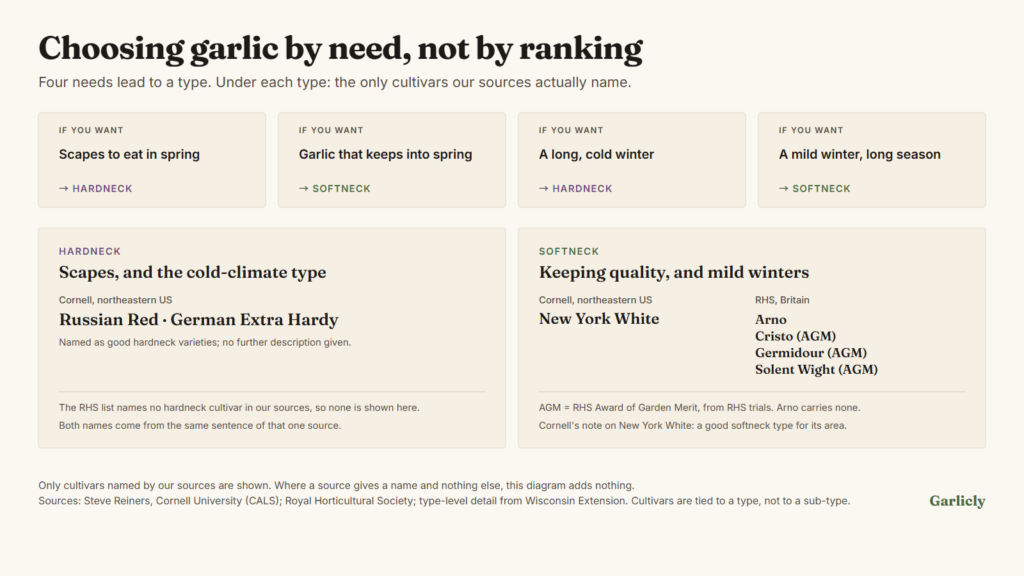
There is no single best garlic variety. There is the best one for what you want out of the crop. Want scapes? That is a hardneck. Want garlic that still keeps in spring? That points to a softneck. Long, cold winter? Hardneck types were selected for exactly that. Mild winter and a long season? The softnecks have the advantage.
So this is a guide to choosing by need rather than a league table, and it is deliberately narrow: it covers the seven varieties our sources actually name — three from Cornell for the northeastern United States, four from the Royal Horticultural Society for Britain — plus the type-level detail from Wisconsin Extension that lets you choose sensibly even where no named cultivar appears in the sources.
That last part is the honesty clause of this page. Several well-known variety names you will see elsewhere do not appear in our sources, so they do not appear here. Where a source gives a name and nothing else, we say so instead of inventing a flavour profile.
Pick by need, not by ranking
If you want scapes
Hardneck. Cornell puts it plainly: hardneck varieties produce a "false" flower stalk called a scape in spring, removing the scape gives you larger bulbs, and the scapes themselves are good in the kitchen 1.
Wisconsin adds the trade-off with numbers: leaving the scape on can cut yield by up to 30 percent in poorly fertilized soil, but by less than 5 percent where fertility is good 3. It also notes some circumstantial evidence that leaving the scape until it turns woody may improve storage life — a claim the page itself frames as tentative, not settled 3.
If you want garlic that keeps
Softneck, on the evidence of every source here. Wisconsin gives them 10 to 40 cloves per bulb and the longest keeping of any group 3; Utah State says softnecks "store very well" and are the type preferred for braiding, while hardnecks have a shorter store life 4.
Within the hardnecks there is a real spread, which is the useful part: Rocambole is the shortest-keeping group, Porcelain keeps markedly longer, and Purple Stripe sits a little above Rocambole 3. None of the seven named varieties has a storage figure of its own in our sources, and the month figures by type belong to the storage guide, along with the temperature and humidity that make them possible.
If your winter is long and cold
Hardneck. Wisconsin's type description is that they "perform best where winters are long and the season of vegetative growth is relatively short" 3, and Cornell calls hardnecks the more winter-hardy type and the most popular one in its region 1.
If your winter is mild and your season long
Softneck. They are described as better adapted to long seasons and mild winters 3, and within them Silverskin performs best in mild winter climates while Artichoke is the most adaptable group of all — the type grown commercially in California 3.
One practical bonus from Wisconsin: Artichoke types do not seem to need winter cold as much, so they are the ones that suit spring planting 3.
The seven varieties our sources cover
| Variety | Type | Where the source places it | What the source says |
|---|---|---|---|
| Russian Red | hardneck | Northeastern US (Cornell) | Named among "good hardneck varieties." No further description. |
| German Extra Hardy | hardneck | Northeastern US (Cornell) | Same sentence, same absence of detail. |
| New York White | softneck | Northeastern US (Cornell) | "A good soft neck type for our area." |
| Arno | softneck | Britain (RHS) | Ivory-white skin; stores well. |
| Cristo (AGM) | softneck | Britain (RHS) | White bulbs; strong flavour but a light aroma. |
| Germidour (AGM) | softneck | Britain (RHS) | "Well known and reliable"; large bulbs. |
| Solent Wight (AGM) | softneck | Britain (RHS) | "Well adapted to the British climate"; stores well. |
Cornell names its three varieties and stops there — no clove counts, no flavour notes, no storage estimates 1. That is not an omission we can repair without leaving the sources, so the table says what the sources say and nothing more.
The British four are candidates, not a shortlist
Read the RHS's own wording for Solent Wight: "well adapted to the British climate" 2. Britain's growing conditions — cool, damp, mild winters — are not the same test as a continental winter in zones 3 to 5, and an RHS recommendation is a statement about RHS conditions.
Cornell's advice for its own region is the pattern to copy anywhere: find varieties that already work where you garden, ask growers at a farmers' market what they are selling, buy a few bulbs, and plant those 1.
So treat the four British names as candidates worth trialling, not as a ranking that transfers to your garden. If a hard winter is your limiting factor, the two Cornell hardnecks are the names our sources actually tie to a cold region.
What the AGM means, and what it does not
Three of the four RHS varieties carry an AGM — the RHS Award of Garden Merit — which the RHS describes as showing that a variety "performed well in RHS trials" 2.
That makes it the only trial-based signal in our whole source set, and it is a genuinely useful one: it means someone grew the plants side by side and judged them. It does not mean a variety suits your climate, and its absence is not a verdict — Arno carries no AGM and the RHS still recommends it, describing it as storing well 2.
This is also why this page has no ranking. Ranking named varieties against each other needs head-to-head trials in comparable conditions, and our sources do not contain any.
If you would rather choose by type
The named-variety record is thin, but the type-level record is not. Wisconsin Extension describes five sub-types in detail 3:
| Sub-type | Cloves | Keeping | Where it fits |
|---|---|---|---|
| Rocambole | 6–11, plump, easy to peel | Shortest of the hardnecks | Long, cold winters; grown for flavour |
| Porcelain | 4–6 large, harder to peel | Longer than Rocambole | Cold winters; uncommon in North America; flavour intensifies in storage |
| Purple Stripe | 8–12, easy to peel | Slightly longer than Rocambole | Cold winters; scapes curl close to a full turn |
| Artichoke | Two layers, tight skins, hard to peel | Long (softneck) | Most adaptable; the California commercial type; suits spring planting |
| Silverskin | 8–12 or 18–24 | Long (softneck) | Mild winter climates |
Wisconsin Extension describes these sub-types at the type level and does not attach them to individual cultivars we can cite 3. That is why the table carries no variety names in its rows, and why the seven varieties above are not labelled Rocambole, Porcelain, or Purple Stripe: no source in our set makes that link for Russian Red, German Extra Hardy, or New York White, and we are not going to guess it.
For what actually separates the two families — scapes, clove counts, braiding, storage behaviour — see hardneck vs softneck; this page only keeps the attributes that matter for choosing.
Buy from a grower, not the grocery store
Both horticultural authorities say the same thing for different reasons. Cornell warns that supermarket garlic was likely grown in China and may have been treated with a sprout inhibitor, so even if it grows it will not do well 1. The RHS puts the emphasis on biosecurity: imported supermarket bulbs may be unsuited to the local climate and can carry disease 2.
Both point to the same alternative: named varieties from a garden centre, a mail-order supplier, or — Cornell's preference — a local grower who is already succeeding with garlic in your area 1, 2.
FAQ
Are these really the best varieties?
They are the best-documented ones in our sources, which is a different claim. Fit to your climate and your use matters more than any list position, and our sources contain no head-to-head trial that would justify ranking them.
Why are five of the seven softnecks?
Because that is what the sources name. The RHS's recommended list is softneck; Cornell names two hardnecks and one softneck. We are not padding the list with names we cannot document.
Will a British variety grow in zone 5?
Our sources do not say, and the RHS's phrase — adapted to the British climate — is a warning rather than a promise. If you want to try one, start with a few bulbs and see how it overwinters where you are.
How long will they keep?
Direction only: hardnecks shorter, softnecks longer, with Porcelain and Purple Stripe the better-keeping hardnecks 3, 4. The month figures, and the temperature and humidity to hit them, are in our curing and storage guide.
Next steps
- Hardneck vs softneck garlic — the two families compared, and why Chinese sources split them differently.
- When to plant garlic in fall — the zone calendar, so a new variety goes in at the right time.
- How to cure and store garlic — where the storage months actually live.
- The grow-garlic hub — the whole cycle from clove to bulb.
Sources
- Steve Reiners, Cornell University (CALS), Plan on Garlic This Fall (2020-08-21): https://cals.cornell.edu/school-integrative-plant-science/school-sections/horticulture-section/outreach-and-extension/pandemic-vegetable-gardening/pandemic-vegetable-gardening-2020-archive/plan-garlic-fall
- Royal Horticultural Society, How to grow garlic (updated 2026-09-09): https://www.rhs.org.uk/vegetables/garlic/grow-your-own
- Susan Mahr and Lauren Mortenson, University of Wisconsin-Madison Division of Extension, Garlic, Allium sativum (rev. 10/2023): https://hort.extension.wisc.edu/articles/garlic-allium-sativum/
- Utah State University Extension, Garlic in the Garden: https://extension.usu.edu/yardandgarden/research/garlic-in-the-garden