On this page (7)
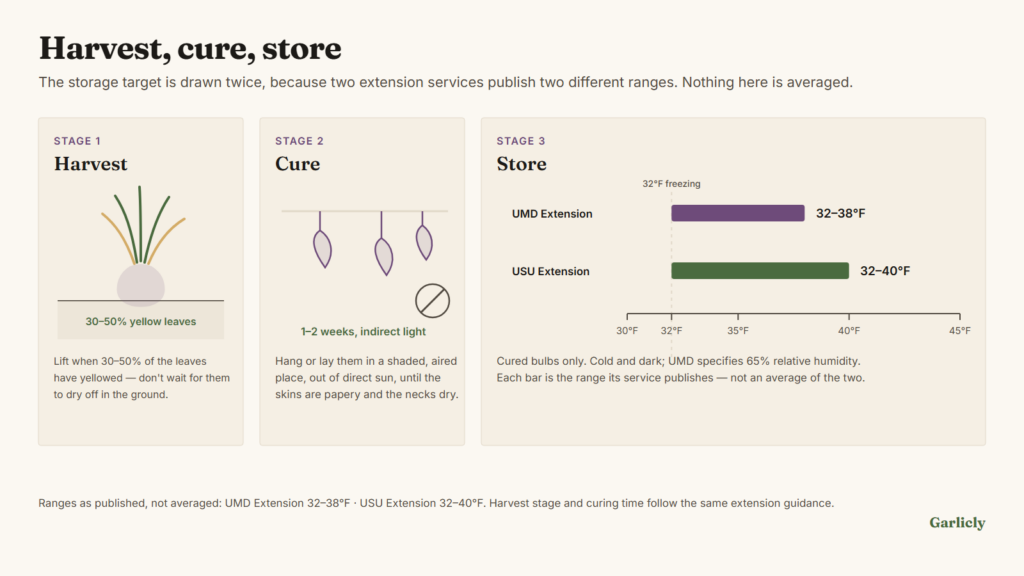
Harvest garlic when about 30–50% of the leaves have yellowed, cure it in a shaded, ventilated place for one to two weeks, then store it cool and dry. That is the whole pipeline. The details below come from a Chinese field walkthrough and two US extension guides — and where the guides give different numbers, we show both instead of blending them.
When to harvest
The Chinese walkthrough gives the field cue: dig when about 30–50% of the leaves have started to yellow and die back 1. Harvest too late and the crop can run into the rainy season — bulbs rot or the cloves split apart, and quality drops 1. Pick the last day of a run of dry weather, not a rainy day or the day after rain 1. Pull by the stem close to the bulb so you do not wound the bulb itself, and cut the roots off right away 1.
If the bed was under plastic film, the film comes off when the leaves yellow and dry; the grower then harvests, here by machine 2, and dries the bulbs in the sun afterwards 2.
The US guides say the same thing in their own words. Maryland: lift the plants when about half the foliage has turned brown, using a garden fork 3. Utah: harvest when the tops begin to yellow or start to fall over, but before they are completely dry 4. One Chinese grower's rule of thumb for the calendar is 120–150 days from planting, depending on variety — and no second source in this article repeats it 2.
The three cues — 30–50% yellow, half the foliage brown, tops starting to fall — are different wordings for the same stage; none of them says to wait until the leaves are completely dead 1, 3, 4.
One more note from Maryland, and only that: as harvest approaches, watering should become less frequent to avoid disease problems 3.
Curing: dry them before you store them
The Chinese walkthrough's method is two-stage. First, leave the pulled bulbs on the ground for 2–3 days to dry 1. Then tie several bulbs together, outer skin still on, and hang them under the eaves or in another place rain cannot reach 1. Hung that way, the walkthrough says, garlic keeps a long time at ordinary room temperature and does not sprout easily 1.
The extension guides give the same idea with their own timelines. Maryland: dry the plants with the tops attached in a well-ventilated place out of direct sunlight — screens in a carport or on a porch work — and cut the tops off after 7–14 days, unless you intend to braid the bulbs 3. Utah: dry the whole plant in a shady, warm spot for 1–2 weeks, then braid the bulbs or store them in open mesh sacks 4. Utah also suggests braiding as one of the hanging options; it does not give a method, and we are not adding one.
Both guides dry the whole plant, tops attached, rather than trimming first — Maryland only cuts the tops after the 7–14 days, and Utah moves the entire plant to its drying spot 3, 4. Utah gives the finish line for curing: when the skins are papery and the roots are dry, the crop is ready to store, and for stored bulbs it cuts the leaves back to 1–2 inches above the bulb 4.
One difference in first-stage practice is worth noting rather than smoothing over: the Chinese walkthrough dries the pulled bulbs flat on the ground for 2–3 days before tying and hanging them 1, while Maryland's curing instruction specifies a place out of direct sunlight 3. The two accounts describe practice in different climates; we are not merging them into one rule.
Maryland's 7–14 days and Utah's 1–2 weeks describe the same window, stated two ways; we have kept each guide's wording rather than collapsing them into a single number.
Storage: cool, dry, and attributed
Back to the field walkthrough: once the bulbs are dry, hang them where rain cannot reach and cut them off as you need them 1. If you want to freeze garlic rather than hang it, the same walkthrough has a kitchen use: mince the cloves, spread them thin, wrap and freeze 1 — that is for chopped garlic, not for keeping whole bulbs. If you would rather keep it as powder, the swap back to cloves is not one for one — how much garlic powder equals a clove starts from the only sourced figure we have.
The extension guides differ in their numbers, so here they are separately, not averaged:
- Maryland: store at 32–38 °F (0–3 °C) and 65% relative humidity, one or two layers deep in a ventilated bag or container; bulbs keep 6–9 months under those conditions 3. The same guide notes that softneck garlic keeps longer than hardneck 3.
- Utah: store at 32–40 °F (0–4 °C), dry, and do not let the bulbs freeze; mesh sacks or braided ropes both work 4.
That softneck-versus-hardneck point is worth knowing before you plant: softneck, the type usually sold in grocery stores, is the keeper; hardneck is the one to work through first 3.
That is a two-degree difference at each end of the cold range. We are not going to average the two into an invented "ideal"; both guides agree on cold, dry, ventilated storage, and differ at the edges. If you have only one cool corner to work with, Maryland's range is the more specific of the two — it names a humidity (65%) as well as a temperature.
The Chinese walkthrough, for its part, gives no shelf-life figure at all — only that hanging keeps the bulbs "a long time" and they do not sprout easily 1. The six-to-nine-month number is Maryland's, for its stated conditions, and should be read that way.
Why a crop fails in storage
Three failure modes show up in the sources, and each traces back to a step above:
- Rot at harvest. Harvest late into wet weather, and the bulbs can rot or split before they ever reach storage 1.
- Neck rot. Utah's disease table lists neck rot as a storage problem that follows excess moisture near harvest and inadequate curing: keep the end of the season dry and cure the bulbs well before storing them 4.
- Sprouting. Bulbs hung dry in a rain-sheltered spot resist sprouting in the Chinese account 1; the extension guides get the same effect by storing cold and dry 3, 4.
If a bulb softens or goes mouldy, one of the earlier steps was skipped — usually curing.
Seed for next year
Utah's guide keeps the largest, healthiest bulbs back as planting stock 4, and Maryland's says to buy certified, disease-free bulbs from a reputable seed source rather than planting grocery-store garlic, which may carry disease without showing it 3.
Next steps
- When to plant garlic in fall — the zone calendar, so the next crop starts on time.
- The grow-garlic hub — the pillar page, from clove to bulb.
- How to plant garlic, step by step, and mulching after planting — companion guides, linked once they publish.
Sources
- 蔬菜小白_beginner, 【大蒜种植教学】从种植到收获全流程|浇水施肥、摘芽、病虫害、保存一次讲清楚! (1,181 s, 2025-11-23): https://www.bilibili.com/video/BV1cnU4BeEfo — harvest, curing and storage section.
- 21世纪农业, 大蒜的一生|现代农业种植和收获大蒜 (329 s, 2023-04-28): https://www.bilibili.com/video/BV1NZ4y1A7QY — subtitle status weak; the cited lines were checked against the track.
- University of Maryland Extension, Growing Garlic in a Home Garden (updated 2023-08-22): https://extension.umd.edu/resource/growing-garlic-home-garden
- Utah State University Extension, How to Grow Garlic in Your Garden (published 2020-05): https://extension.usu.edu/yardandgarden/research/garlic-in-the-garden