On this page (9)
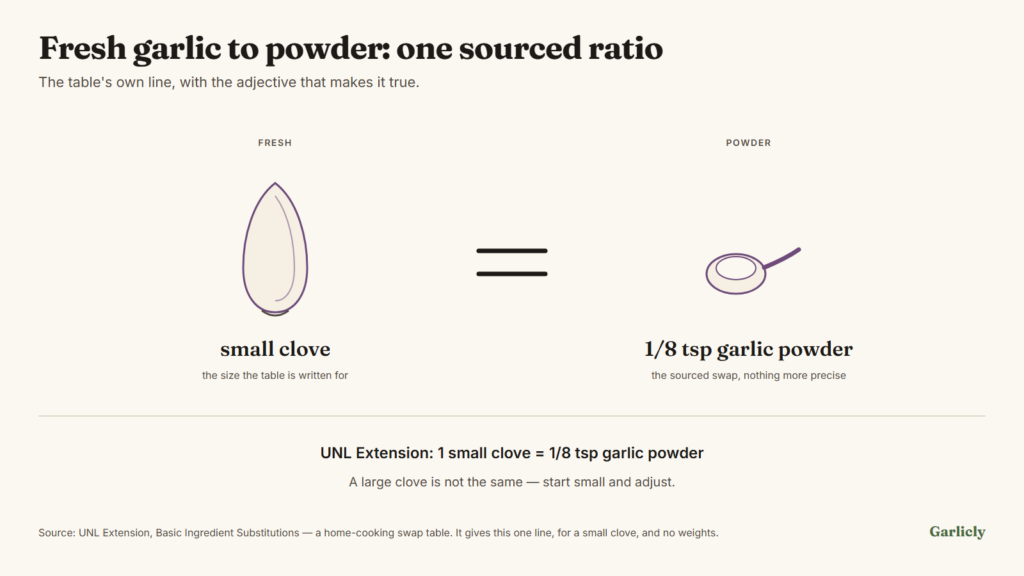
According to UNL Extension's substitution table, one small clove of garlic equals about 1/8 teaspoon of garlic powder. The word earning its keep in that sentence is "small." The table is written for a small clove, and a large clove is a different quantity of garlic altogether — so treat 1/8 teaspoon as a starting point for a small clove and as somewhere to begin, not to stop, when your cloves are big.
That is the honest answer to "how much garlic powder equals a clove". Everything after this point is either the source's single line or our own kitchen judgement, marked as such, because a substitution table cannot tell you how your particular powder and your particular garlic will taste together.
What the source actually says
The line is from UNL Extension's Basic Ingredient Substitutions, a home-cooking swap table, and it reads, verbatim: "Garlic 1 small clove 1/8 teaspoon garlic powder" 1.
Read what kind of document that is. It sits among rows for self-rising flour and fresh herbs, in a table built to help a cook finish a recipe when an ingredient is missing 1. It is not an analytical conversion: it gives no weight in grams, no equivalent for granulated garlic, and no definition of what "small" means for a clove. It is a good answer to a practical question, and it is the only figure in this article that comes from a source.
Why it cannot become a universal rule
Three reasons, and this part is our assessment, not the source's:
- Powder varies. Brands differ in how finely they grind and how strongly the powder tastes; granulated garlic is a different product again from powder, and the table covers only powder 1.
- Fresh garlic varies more. Pungency changes with variety, with growing conditions, and with how long the bulb has been in storage. Two cloves of the same size can taste different.
- Clove size varies most of all. Within one bulb, a large clove can weigh more than twice a small one — our estimate, since the table gives no weights at all.
Put together, that means 1/8 teaspoon is a reasonable swap for a small clove and a weak one for a big clove. Anyone quoting the ratio without the adjective has quietly deleted the only part of the line that makes it true.
Where the two behave differently in the pan
Also our kitchen judgement, not from the table:
Fresh garlic brings water and texture with it. It releases that water as it cooks, it gives a raw, sharp bite when uncooked, and its aroma fades the longer it is heated — which is why a dish can taste strongly of garlic at the start and mildly of it at the end. It also scorches quickly in a hot pan.
Powder brings neither water nor texture. It disperses into dry rubs, marinades, and dressings, it blooms in fat, and its flavour is flatter but more stable through long cooking. What it does not do is give you the fresh bite of a clove stirred into a dressing at the end.
So:
- Reach for fresh when the garlic is the point of the dish — raw dressings, a quick sauté, a finishing oil, anything where you want the sharpness and the aroma to still be there on the plate.
- Reach for powder when you want garlic without extra water or texture — dry rubs, spice blends, long braises and stews, marinades, and dressings where a spoonful of fresh would thin the texture.
That is a rule of thumb about cooking, not a conversion table, and it will not survive every recipe.
At the counter
- A small clove: 1/8 teaspoon of powder, per the table 1.
- A large clove: start at 1/8 teaspoon, then add in small increments and taste. We are not giving a bigger number because no source gives one, and inventing "1/4 teaspoon for a big clove" is exactly the kind of figure that turns a substitution into a mistake.
- Raw applications: err low, then adjust. Powder's flavour is concentrated and one-dimensional, and it is easier to add than to remove.
- Long-cooked dishes: powder can go in early; fresh is better added later, where its aroma survives.
The tools, briefly
Our assessment again: the equipment is part of which form you end up using. A press or a knife is the cost of fresh garlic, and crushing a clove releases more of the pungent compounds than slicing it does — which is also why pressed garlic tastes fiercer than the same clove chopped. Powder needs nothing but a measuring spoon and a jar with a lid, which is why it wins on a weeknight when the alternative is peeling.
Keeping both is not a compromise, it is a division of labour: fresh for the dishes where garlic is the point, powder for the pantry shelf and the dry rub. What we would not do is buy a gadget first and decide later what to cook with it.
What the table does not cover
- Grams. If you are baking or working by weight, this table will not help you; it is volumetric.
- Granulated garlic. A different product from powder, and outside the table's row 1.
- Garlic salt. Our note, not the source's: garlic salt is salt mixed with garlic, so it is not a one-for-one swap for powder — you would be adding salt with every teaspoon.
- Roasted or black garlic. No substitution guidance anywhere in the table.
FAQ
Is it 1/8 teaspoon for every clove?
No. The table says a small clove 1. For a large clove, start there and build up to taste — we have no sourced figure for big cloves.
Can I swap powder for fresh in any recipe?
The table treats it as a substitution 1, but texture and water change, so it works best where the dish will not miss the fresh garlic's moisture or bite.
What about a recipe that calls for "1 clove"?
Check the clove in front of you. If it is small, 1/8 teaspoon is the sourced swap; if it is fat, begin at 1/8 and adjust.
Next steps
- Garlic substitutes — the kitchen hub for swaps and stand-ins.
- How to store fresh garlic — so the bulb you are substituting for lasts.
- The grow-garlic hub — if you would rather grow the fresh half of this comparison.
Sources
- University of Nebraska–Lincoln, Food, Basic Ingredient Substitutions (updated and reviewed 2026): https://food.unl.edu/article/ingredient-substitutions/