On this page (11)
A garlic scape is the flower stalk a hardneck garlic sends up in late spring — cut it once it has fully emerged and started to curl, while the bud at the top is still closed. Leave it and the plant spends its energy on seed rather than bulb; cut it and you get a bigger bulb plus something to eat.
That much is easy. The detail worth slowing down for is the timing: every source here describes a stage of the plant, not a date, which is why "when to cut garlic scapes" has no single calendar answer. Below are the four stage descriptions side by side, the one sourced instruction on how low to cut, the evidence for cutting at all, and the part of the plant most English-language gardening sites never mention — the buds are food too.
What a scape actually is
Cornell calls it a "false" flower stalk, and the quotation marks are doing real work: it is not a normal flower stem 1. The RHS and Wisconsin both describe what happens if it is left alone — the flowers usually abort and form bulbils, small aerial cloves, instead of seed 2, 4.
It is also the clearest visible difference between the two garlic families in the garden. Hardneck types produce the stalk; softneck types generally do not, which is why softnecks can be braided 1, 4. So if your garlic has sent up a curly green stem, you are growing a hardneck.
In China it is eaten as a spring vegetable in its own right, which is where this page's most useful detail comes from — more on that below.
When to cut: the stage, not the date
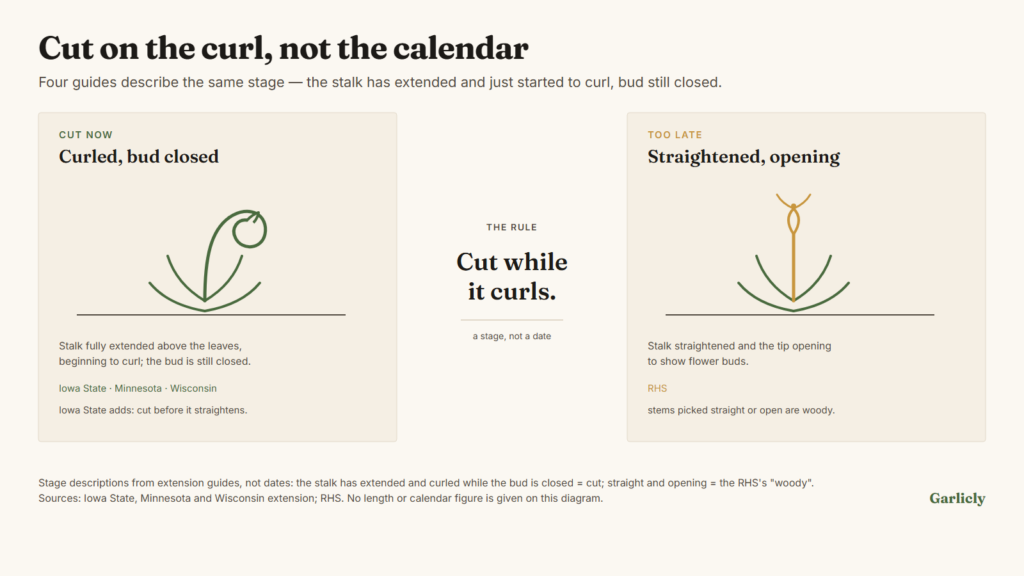
Every source describes the same window in slightly different words:
| Source | The stage it names |
|---|---|
| Iowa State | The stalk fully extended above the leaves and beginning to curl, before it straightens and the bulbous tip opens to reveal flower buds 5 |
| RHS | Remove flower stems "as soon as they start to form" — and pick them young, while the flower is still in bud, because once straight or open they are woody 2 |
| Minnesota | "Just after they start curling" 3 |
| Wisconsin | Just after curling starts 4 |
Four sources, one window: the stalk has come out of the leaves, it is curling, and the bud at the tip has not opened. RHS is the earliest — as soon as the stem appears — and the other three wait for the curl.
None of them gives a number of days after planting, or a month. That is not an omission on our part; it is how the crop is judged. Spring temperatures move the date by weeks, and the plant tells you where it is.
What happens if you don't
The clearest evidence in our set is not from an extension page but from a Chinese field walkthrough, and it is worth describing precisely because it is shown rather than asserted. If the scape is not pulled, the bud at the top flowers and sets seed — and seed production draws heavily on the plant, so the bulbs underneath come out much smaller. The video puts the comparison on camera: the un-pulled plants set seed, and the grower holds up the harvested bulbs to show how much smaller they are than normal ones 6.
That is the mechanism behind the extension advice. Cornell's version is the short one: remove the scape and you get larger bulbs 1.
How much to leave
There is exactly one length instruction in our whole source set, and it comes from Iowa State: cut the stalk off as low as possible without cutting off any leaves 5.
Note what that is and is not. It is a rule relative to the plant — take the stalk, spare the foliage — and it is the only one we have. No source gives a measurement in centimetres or inches, and we are not going to invent "leave two or three centimetres", which is the kind of figure that circulates without a source behind it.
On method, the sources are equally thin: the RHS says to snip the stems off 2, and the Chinese grower describes pulling the scape out 6. Both are in practice. Neither source describes the hand movement, the angle, or how to avoid tearing the leaves — so neither will this page.
Why cut them at all
Two reasons, one agronomic and one culinary.
The agronomic one comes with numbers from Wisconsin: leaving the scape on can reduce yield by up to 30 percent in poorly fertilized soil, but by less than 5 percent where fertility is good 4. Note that the penalty depends on how well fed the plants are, which is why the scape is sometimes described as free to leave — in a well-fed bed it nearly is. Wisconsin also mentions some circumstantial evidence that leaving the scape on until it turns woody may improve storage life, and flags it as just that: circumstantial 4. We would not build a plan on it, but it is the reason you will see the advice to "leave them if you can't be bothered" in well-managed gardens.
The culinary one: the scape is good eating if you take it young, and woody if you don't 2, 4.
How to use them
Young scapes are tender enough to cook whole. The RHS lists them sautéed, barbecued, or roasted, picked while the flower is still in bud 2. Minnesota notes they can be eaten and that mature scapes also work in flower arrangements, which is a useful second life for the ones you cut too late to enjoy 3.
Past the bud stage the texture changes for good: once the stalk is straight or the flowers are out, the RHS and Wisconsin both describe it as woody 2, 4. At that point it is a plant part to remove, not a vegetable.
Don't throw away the buds
Here is a detail the English-language pages in our source set never mention, and the Chinese material is emphatic about it: the bud at the tip — the "scape top", 蒜苔帽 — is edible, and it should not go in the compost. One kitchen video builds a whole dish around them, noting that people trim them off and discard them without realizing they are food, and that they are as nutritious as the stem 7.
So when you snap or cut the scape, keep the bud. Cook it with the stem, or use the buds alone. We are not going to print a recipe for them — that is a different kind of site — but the instruction "don't discard them" is the useful part, and it costs nothing.
If you would rather skip the job
Grow a softneck. They generally do not produce a scape at all, which is exactly why they are the type that can be braided 1, 4 — and why a softneck bed has no scape harvest built into it.
The alternative route — planting the bulbils that form on an uncut scape — exists, but Wisconsin is blunt about the cost: the bulbs they form are very small and take two or three years to reach usable size 4. That is a project, not a shortcut.
FAQ
Do all garlics make scapes?
No. Hardneck types do; softneck types generally do not 1, 4. If your plants never send one up, you are probably growing a softneck — our sources tie scapes to the type, not to a particular bed.
What if I cut too early?
The RHS's "as soon as they start to form" is the earliest guidance in our sources 2, so cutting at emergence is within what is described. Our sources do not cover cutting before that, and we have nothing to say about it.
What if I miss the window?
Cut it anyway. The scape will be woody and no good to eat 2, 4, but leaving it directs the plant's energy into seed 6. Wisconsin's circumstantial note about storage is the only argument for leaving a mature scape on, and it is not strong enough to plan around 4.
Can you eat them raw?
Our sources describe cooking — sautéed, barbecued, roasted 2 — and none of them says raw. That is as far as we can take it.
Next steps
- Hardneck vs softneck garlic — which types make scapes, and why.
- The grow-garlic hub — the whole cycle from clove to bulb.
Our guide to when to harvest garlic — the leaf signals, and what early and late cost you — is linked here once it publishes.
Sources
- Steve Reiners, Cornell University (CALS), Plan on Garlic This Fall (2020-08-21): https://cals.cornell.edu/school-integrative-plant-science/school-sections/horticulture-section/outreach-and-extension/pandemic-vegetable-gardening/pandemic-vegetable-gardening-2020-archive/plan-garlic-fall
- Royal Horticultural Society, How to grow garlic (updated 2026-09-09): https://www.rhs.org.uk/vegetables/garlic/grow-your-own
- University of Minnesota Extension, Growing garlic in home gardens: https://extension.umn.edu/garden-and-home/yard-and-garden/gardening-in-minnesota/growing-garlic
- Susan Mahr and Lauren Mortenson, University of Wisconsin-Madison Division of Extension, Garlic, Allium sativum (rev. 10/2023): https://hort.extension.wisc.edu/articles/garlic-allium-sativum/
- Iowa State University Extension and Outreach, Growing Garlic in the Home Garden: https://yardandgarden.extension.iastate.edu/how-to/growing-garlic-home-garden
- 墨澜时光9, 蒜头长不大10个原因,种出比拳头大的蒜头,种蒜提示最全 (651 s, 2021-10-06; weak subtitle, spot-checked at 09:26–10:11): https://www.bilibili.com/video/BV1Sq4y1V74n
- 小芳爱美食, 择下来蒜苔尖扔了太可惜了,教你新吃法,不炒也不炸,真的太香了 (304 s, 2023-04-19): https://www.bilibili.com/video/BV1jg4y1M7KA