On this page (14)
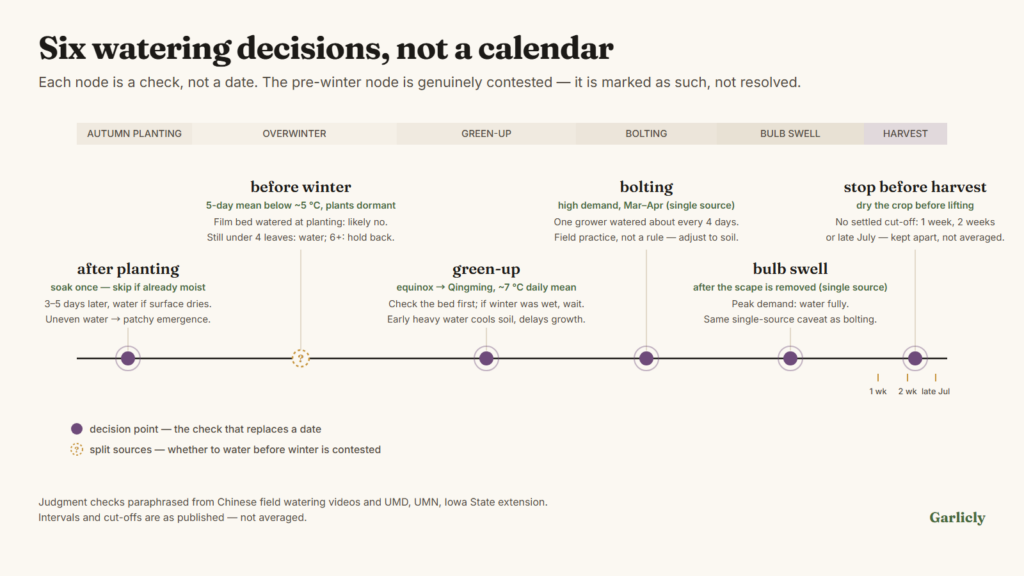
Water garlic by need, not by calendar: soak the bed at planting, water again only if the soil is dry a few days later, treat the pre-winter watering as a judgment call, and keep moisture steady from green-up through bulbing — then stop in time for harvest. Garlic roots are shallow and hold little water, so the crop forgives a missed week far better than a permanently wet bed 4. This guide follows the season, but every node is a decision, not a date.
The one measurement that replaces a schedule
Before any watering question, check the soil at root depth — a hand, a trowel, or a cheap moisture probe all work. The videos in this guide use the same logic from different directions: garlic roots are shallow and need frequent attention 4, but too much water is as damaging as too little, and drainage after rain matters 4. Climate, soil type and the year's rainfall decide more than any calendar does, which is why this page gives you the checks instead of dates.
1. After planting: soak once, then watch
The planting-day routine is a single thorough soak of the planting furrow; if the soil is already moist, the same source says you can skip the water entirely 4. Water again three to five days later if the surface has dried, because uneven watering is the main cause the video gives for patchy emergence 3. About a week after planting, if the bed is dry, one more light watering helps the seedlings; the video adds a little fermented manure to that water, which is optional 4. Do not overdo it: too much water and no drainage is how young garlic drowns, which is why the same source says to drain after rain 4.
2. Before winter: the one genuinely contested node
What the pre-winter watering is for
The Chinese field account gives four purposes for the "封冻水" (the freezing-season watering): it improves soil structure as the water expands and breaks up clods; it prevents the spring drought that can dry the young plants out ("返阳洞"); it stabilizes soil temperature against swings and protects against freeze damage; and it fills soil pores so cold air cannot reach the roots 1.
When to do it
Late rather than early. The video says the field should be watered once the five-day average temperature is below about 5 °C and the plants have gone dormant — watering while they are still growing pushes soft growth and lowers cold hardiness 1.
Whether to do it at all
This is where the sources split, and we are not going to pick a side for you. One video says a field that was watered before the film went on does not need winter water — extra water lowers soil temperature, dulls the film's light transmission, can spread rot bacteria and leaches fertilizer — while a field showing fertilizer burn does need water, generously 2. Another takes a plant-stage view: garlic is most cold-hardy around six leaves; if the plants have not reached four leaves before the frost, water more so they can grow; if they are at six leaves or beyond, water less or even hold back, to push roots deeper 5.
So the judgment is a short checklist:
- Is the bed under film, and was it watered at planting? Then it likely does not need winter water 2.
- Are the plants still below four leaves? Water to help them catch up before the cold 5.
- Are they at six leaves or more? Hold back or water lightly, to deepen the roots 5.
- What does the soil say? A fast-draining sandy bed will need more than a heavy clay one — that is our judgment, not a source rule.
3. Green-up: water with the first growth
As the crop wakes up in spring, it needs a first watering — but not an early or heavy one. The source warns that the plants are just waking and need to adapt; over-watering cools the surface soil and delays early growth 4. The timing the Chinese videos use is after the spring equinox and before Qingming, around a daily mean of 7 °C 6. Check the soil first: if the winter and early spring have been wet, wait.
4. Bolting: a single-source account
One general watering video does cover the bolting stage, so we include it — but with a caveat: it is the only source in our material that does, and it is a general watering method rather than a dedicated trial. In March and April, as the flower bud differentiates and the scape and bulb grow together, the crop's water demand is high; the video waters about every four days 4. Treat the interval as one grower's field practice and adjust to your soil.
5. Bulb swell: also single-source
After the scape is removed, the bulb enters its rapid growth phase and the video says to water fully — this is the stage where the crop needs the most water 4. Same caveat: one source, so read your bed rather than copying the interval.
6. Stop before harvest
The sources differ on the exact cut-off, and we are keeping them apart:
- The Chinese watering video says to stop about a week before harvest, keep the field drained, and reduce the water content of the bulbs for storage 4.
- Minnesota says to stop watering two weeks before harvest, to avoid staining the bulb wrappers and promoting disease 8.
- Iowa State says to stop irrigating in late July, to let the foliage die down 9.
- Maryland says watering should become less frequent as harvest approaches 7.
The principle is the same in all four — dry the crop out before lifting — but the number of days is not settled. If your harvest date is uncertain, two weeks is the earlier, safer cut-off.
What we can't tell you
- A field-drainage guide. The sources say "drain after rain" and "grow in well-drained soil" 4, 7, but none of them is a dedicated drainage guide, so we are not writing one.
- A second source for bolting and bulb-swell watering. The only account we have is the general video above 4; treat those two nodes accordingly.
- A climate-specific calendar. The whole point of this page is that your soil, rainfall and winter decide; a fixed schedule would be wrong somewhere.
FAQ
How often should I water garlic?
Check the soil at root depth; water when it is dry, not on a fixed day. The sources' intervals are field practice, not a rule 1, 4.
Should I water before winter?
It depends on film, planting-time moisture and leaf stage — the checklist in section 2 is the decision process 2, 5.
When do I stop watering?
One to two weeks before harvest, depending on which guide you follow; two weeks is the safer cut-off 4, 8, 9.
Next steps
- When to plant garlic in fall — the zone calendar, so the planting soak happens at the right time.
- The grow-garlic hub — the pillar page, from clove to bulb.
- The feeding schedule, yellow-leaf diagnosis, curing and storing, and mulching — companion guides, linked once they publish.
Sources
- 爱华生活记, 大蒜越冬前,浇封冻水有什么用?什么时间浇最好?4个作用很重要 (317 s, 2023-02-16): https://www.bilibili.com/video/BV1n24y1p7Aj — four purposes and the timing window.
- 农业技术分享2022, 大蒜要不要浇越冬水? (142 s, 2022-10-27): https://www.bilibili.com/video/BV1gg411h7xS — when winter water is unnecessary and when it is needed.
- 农民云飞V, 大蒜啥时候可以浇水?大蒜为啥会出苗不齐? (173 s, 2024-10-02): https://www.bilibili.com/video/BV1wz4uepEw2 — after-planting rhythm.
- 农民云飞V, 大蒜怎样浇水好?浇这几遍水时加点东西,蒜骨头结的大没病害 (222 s, 2022-10-09): https://www.bilibili.com/video/BV1PW4y1H7M3 — the five-stage watering method, single source for bolting and bulb swell.
- 越冬水又叫防冻水,哪些菜需多浇?哪些需少浇? (141 s): https://www.bilibili.com/video/BV1GBUAYsEw5 — leaf-stage judgment for pre-winter water.
- 康达农资, 年后大蒜返青肥,尿素,复合肥,硝酸铵,用那个好 (135 s, 2024-01-03): https://www.bilibili.com/video/BV1qC4y1i7fz — green-up water timing.
- University of Maryland Extension, Growing Garlic in a Home Garden (updated 2023-08-22): https://extension.umd.edu/resource/growing-garlic-home-garden
- University of Minnesota Extension, Growing garlic in home gardens (reviewed 2026): https://extension.umn.edu/garden-and-home/yard-and-garden/gardening-in-minnesota/growing-garlic
- Iowa State University Extension, Growing Garlic in the Home Garden (reviewed September 2026): https://yardandgarden.extension.iastate.edu/how-to/growing-garlic-home-garden