On this page (14)
Garlic supplements may reduce blood pressure and LDL cholesterol "to a small extent" in people who already have high levels, the evidence for colds is very thin, and the health agencies that grade it use words like "limited" and "insufficient". That is the whole verdict, and this page keeps it that narrow: what was tested, in whom, at what study doses, and where the reviews disagree.
Education only, not medical advice. Garlic supplements can interact with medicines, and bleeding risk is the main concern — talk to your clinician before starting or stopping anything. Full medical disclaimer.
A rule for this page: we give no dose recommendations. Where a study dose appears, it is a study parameter, not advice, and we say so each time it appears.
What "garlic supplement" covers
The reviews use the term loosely, so the first thing worth fixing is what was actually tested. A Cochrane review lists the families: raw cloves, essential garlic oil, garlic powder, garlic oil macerates (cloves ground into vegetable oil), garlic extract, and aged garlic extract, where harsh compounds are converted into more stable sulphur compounds 2.
That list matters for every claim below, because preparations differ in how much allicin they can yield, and heat inactivates the enzyme that converts alliin to allicin 2. A trial of one preparation is not a trial of another — and "garlic supplement" on a label does not tell you which one you are holding. For what each of those label words actually means, see the forms that have been studied.
How we read the evidence
The wording we anchor to is the U.S. National Center for Complementary and Integrative Health (NCCIH), which now carries the garlic entry for the National Institutes of Health 1. Where NCCIH gives a sentence, we quote it. Where it gives no effect size, we go to the systematic reviews and meta-analyses, and the table in our notes marks which source each number came from.
A note on sourcing, because it affects how you should read this page. The NIH Office of Dietary Supplements used to publish a garlic fact sheet. As of 7 November 2026 those pages return 404, and ODS's own index routes readers to NCCIH instead 1. ODS's garlic evidence has not disappeared, though: it now sits inside ODS's immune-function fact sheet, which this page also quotes 8. So three authorities are cited here — NCCIH, ODS, and a Cochrane review — and we name which one is speaking every time.
Our own search, for transparency: PubMed was searched on 2026-11-07 with four queries — garlic AND (blood pressure OR hypertension) AND (meta-analysis OR systematic review) (40 records), garlic AND (cholesterol OR lipid) AND (meta-analysis OR systematic review) (68), garlic AND (common cold OR immune) AND (randomized OR systematic review) (77), and aged garlic extract AND randomized (131). Records were screened for systematic reviews and meta-analyses of randomised trials. Where we cite a review we read only in abstract, the source list says so.
Here is the shape of the evidence before the detail. The last column repeats NCCIH's own qualifier for each claim — our shorthand for NCCIH's wording, not a grading system; it exists so the table can be read at a glance, and it follows NCCIH's language rather than replacing it.
| Claim | NCCIH wording, verbatim | Who was studied | Study doses and forms | What the numbers show | NCCIH's own qualifier |
|---|---|---|---|---|---|
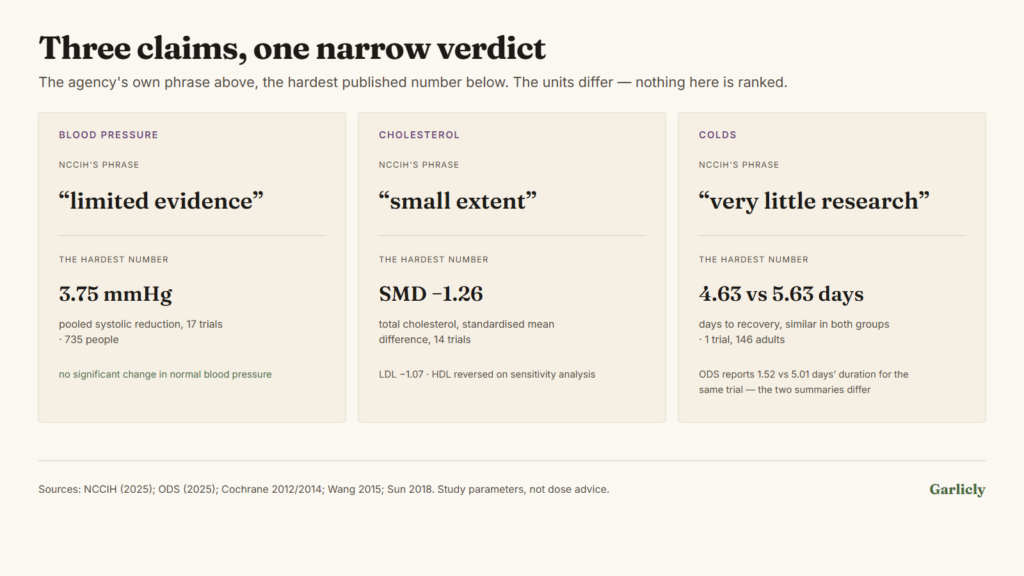
| Blood pressure | "Limited evidence suggests that garlic supplements may reduce blood pressure to a small extent in people who have high blood pressure." | Hypertensive adults: 2 trials / 87 people (Cochrane); 17 trials / 735 in the pooled systolic analysis | Garlic powder 200 mg × 3/day × 12 weeks (Cochrane); 300–2400 mg/day for 2–24 weeks (pooled) | Pooled systolic −3.75 mmHg; hypertensive subgroup −4.4 mmHg; no effect in normotensive people; clinical outcomes unproven | "limited evidence" |
| LDL and total cholesterol | "Garlic supplements may reduce levels of total cholesterol and low-density lipoprotein (LDL) cholesterol to a small extent in people who have high blood cholesterol levels." | Adults with high cholesterol: 14 trials published 1981–2016 | 0.3–20 g/day; aged black garlic, garlic oil, garlic powder | Total cholesterol SMD −1.26; LDL −1.07; triglycerides no significant change; HDL result reversed on sensitivity analysis | "may… to a small extent" (no scarcity word used) |
| Immune function and colds | "However, very little research has been done on this topic…" — a 2022 review found two small studies with weaknesses | 146 adults in the one trial Cochrane could include | 180 mg allicin daily for 12 weeks | Colds 24 vs 65; days ill 111 vs 366; days to recovery 4.63 vs 5.63 | "very little research" (ODS: "results are inconclusive") |
| Blood sugar | "Garlic supplements may reduce blood sugar to a small extent in people with diabetes." | Not stated by NCCIH | Not stated by NCCIH — no number is given here | No effect size reported by the source | "may… to a small extent" (no scarcity word used) |
| Cancer risk | "Consuming garlic does not seem to reduce the risk of stomach cancer. It's uncertain whether garlic influences the risk of colorectal cancer." | Not stated by NCCIH | — | Two different conclusions for two different cancers | "does not seem" / "uncertain" |
Every dose in that table is a study parameter, not a dose recommendation.
Blood pressure
NCCIH's sentence is the ceiling for this section: "Limited evidence suggests that garlic supplements may reduce blood pressure to a small extent in people who have high blood pressure" 1. Limited, small, and only in people who already have the condition — three qualifiers, all of them load-bearing.
The stricter review behind that caution found only two randomised trials, 87 patients in total 2. One gave 200 mg of garlic powder three times daily for 12 weeks and reported a fall in supine systolic pressure of 12 mmHg and diastolic of 9 mmHg over placebo; the second, which could not be pooled, reported 10–11 mmHg and 6–8 mmHg 2. Those trials used 200 mg of garlic powder three times daily for 12 weeks — a study parameter, not a dose recommendation.
The authors' own caution is the part usually dropped: the confidence intervals "are not precise", the difference "falls within the known variability in blood pressure measurements", and that "makes it difficult, if not impossible, to determine the true impact of garlic on reducing blood pressure" 2. On the outcomes a patient actually cares about, they write: "There is insufficient evidence to determine if garlic provides a therapeutic advantage versus placebo in terms of reducing the risk of mortality and cardiovascular morbidity in hypertensive patients" 2.
The larger pooled analysis points the same way, smaller. A 2015 meta-analysis of 17 trials (735 participants in the systolic analysis) found a pooled systolic reduction of 3.75 mmHg (95% CI −5.04 to −2.45) and diastolic of 3.39 mmHg; in the hypertensive subgroup systolic fell 4.4 mmHg (CI −7.37 to −1.42), while normotensive participants showed no significant change 4. Pooled trials used 300–2400 mg a day for 2–24 weeks, mostly garlic powder, with three aged-extract trials and one garlic-oil trial — study parameters again, not dose recommendations.
One funding note, and it is ours rather than the review's conclusion: those trials largely used commercial preparations, but the meta-analysis does not summarise who funded the original studies, so the honest entry is "not reported" 4.
Why two top-tier reviews disagree
Two of the most authoritative looks at garlic and blood pressure report effects that differ several-fold, and the disagreement teaches more than either number.
First, the Cochrane review rests on two trials and 87 patients, and its authors say the estimate is too imprecise to quantify. An effect of 10–12 mmHg from a sample that size is a signal, not a measurement 2.
Second, the 2015 meta-analysis has 17 trials but a pooled systolic effect of 3.75 mmHg — small enough that its clinical relevance for an individual is uncertain, and absent in normotensive people 4.
Third, neither supports the popular story. The larger synthesis finds a small average effect; the stricter review says the clinical outcomes are unproven. If you came for "garlic lowers blood pressure", the defensible version is: a small average reduction in people who already have high blood pressure, of uncertain clinical meaning.
Blood cholesterol
On lipids, NCCIH is slightly more definite than on blood pressure but still hedged: "Garlic supplements may reduce levels of total cholesterol and low-density lipoprotein (LDL) cholesterol to a small extent in people who have high blood cholesterol levels" 1.
The effect size comes from a 2018 meta-analysis of 14 trials published between 1981 and 2016, covering three preparation types — aged black garlic, garlic oil, and garlic powder — at doses from 0.3 to 20 g a day and follow-up of four weeks to ten months 5. It reports significant reductions in total cholesterol (standardised mean difference −1.26, 95% CI −1.86 to −0.66) and LDL (−1.07, −1.67 to −0.47), no significant change in triglycerides, and an HDL result that reversed direction when some studies were removed 5. Trials used 0.3–20 g of garlic preparations a day for four weeks to ten months — a study parameter, not a dose recommendation.
Two limits belong in the same breath. The pooled effect is a standardised mean difference, not mg/dL: it compares the size of the effect to the variability across studies, and it is not a number you can read off a lipid panel. And a dose range spanning two orders of magnitude means the pooled figure summarises very different preparations, not one product you can buy 5. The authors declare no competing interests; the work was supported by government research funds 5.
Immune function and the common cold
This is where the distance between the marketing and the evidence is widest. NCCIH: "Dietary supplements that contain garlic have been promoted as boosters for the immune system, particularly during cold and flu season. However, very little research has been done on this topic. A 2022 review identified only two studies that suggest a possible benefit, and both studies included only small numbers of people and had weaknesses in the research" 1.
The Cochrane review is just as thin: eight potentially relevant trials, and only one met the inclusion criteria — 146 participants randomised to a garlic supplement containing 180 mg of allicin or placebo, once daily for 12 weeks 3. It reported 24 colds in the garlic group against 65 in the placebo group (P<0.001) and fewer days of illness (111 versus 366), but days to recovery were similar: 4.63 versus 5.63 3. That trial used 180 mg of allicin daily for 12 weeks — a study parameter, not a dose recommendation.
ODS reaches the same verdict from a different angle: "Only a few clinical trials have examined whether garlic supplements help prevent or treat the common cold or influenza, and results are inconclusive" 8. It describes two trials rather than Cochrane's one; the two bodies drew their inclusion lines differently, and we are not going to adjudicate that. The first gave 120 healthy adults 2.56 g a day of aged garlic extract for 90 days and found no difference in the number of illnesses or in symptoms per illness, although the garlic group reported a smaller total number of symptoms; that dose is a study parameter, not a dose recommendation 8. The second is the same 146-person trial Cochrane kept — and ODS reports it differently.
The two agencies describe that trial's duration figures differently, and the difference is worth showing rather than smoothing over. ODS reports that "colds lasted an average of only 1.52 days in the garlic group compared with 5.01 days in the placebo group", and notes that the trial's dose was not specified 8. Cochrane reports "days to recovery" as 4.63 versus 5.63 and records 180 mg of allicin daily 3. Whether those are different endpoints or two ways of summarising one endpoint is not something we can settle from the published abstracts, and we are not going to pretend otherwise. What survives both readings is the direction — fewer colds, and less time ill, in the garlic group — and the direction is all we will take from it. Each figure stays with the agency that published it; we have not averaged them, and we have not picked the friendlier one.
The authors' conclusion is the sentence to keep: "There is insufficient clinical trial evidence regarding the effects of garlic in preventing or treating the common cold. A single trial suggested that garlic may prevent occurrences of the common cold but more studies are needed to validate this finding. Claims of effectiveness appear to rely largely on poor-quality evidence" 3. Adverse effects reported in that trial were rash and odour 3.
Blood sugar
One sentence, and no more: "Garlic supplements may reduce blood sugar to a small extent in people with diabetes" 1. NCCIH gives no effect size and no study count here, so neither will we — adding either would be us writing the source rather than reading it.
Cancer risk
Two claims, kept apart, because the evidence differs. "Consuming garlic does not seem to reduce the risk of stomach cancer", while "it's uncertain whether garlic influences the risk of colorectal cancer" 1. That is the whole of what our main source says, and we are not going to expand it with mechanisms.
What we left out, and why
Some material was left out of the evidence table on purpose, and the reasons are part of the story rather than an omission.
- Animal and in-vitro work. The reviews point to mechanistic studies of allicin and other sulphur compounds, but a mechanism in a dish is not an outcome in a person, so none of it is graded here 2, 5.
- Narrative reviews. One frequently cited review argues that garlic regulates cholesterol and stimulates immunity 6. A narrative review can summarise trials, but it is not itself a trial or a systematic synthesis, so we grade the trials behind the claim where we can read them, not the review's assertion.
- Preparations with no stated allicin yield. Cochrane's background notes that preparations differ in what they can yield and that heat inactivates the enzyme that produces allicin 2. Where a study does not say what its preparation delivers, we will not assume it is equivalent to another.
That last point is the practical one: "garlic supplement" is a category, not an ingredient with a fixed dose.
Safety and interactions
NCCIH's safety section is more specific than most marketing copy, and every claim in this section is theirs 1.
- Bleeding risk. "Taking garlic supplements may increase the risk of bleeding… This is especially important if you are going to have surgery or if you take medicines, such as anticoagulants or aspirin, that may also affect bleeding" 1.
- Tell your providers. If you take anticoagulants, aspirin, or any other medicine, "talk with your health care provider before using garlic or other herbal products; some herbs and medicines interact in harmful ways" 1.
- Common side effects. "Breath and body odor, abdominal pain, flatulence, and nausea", plus allergic reactions in some people 1.
- Long use. Garlic taken orally "has been used safely in research studies that lasted as long as 7 years" 1.
- Pregnancy and breastfeeding. Garlic "may not be safe for use during pregnancy or while breastfeeding when taken orally in amounts greater than those found in foods" 1.
- Topical raw garlic. Fresh raw garlic "may not be safe when used topically. It can cause severe skin irritation and chemical burns" 1.
That list is not exhaustive, and it is not a substitute for your own clinician's view of your own medications.
The regulatory picture
The usual phrasing — that supplements are not approved before sale — is actually in the source, so we can quote it rather than paraphrase: "Unlike drugs, dietary supplements are not approved by the U.S. Food and Drug Administration (FDA) before they are sold to the public" 1. What follows is the part people skip: "Manufacturers and distributors of supplements are responsible for evaluating the safety and labeling of their products before marketing to ensure that they meet all regulatory requirements" 1, and the FDA's role is to act when public-health concerns arise 1.
The FDA's own page puts the same structure in legal terms: firms are "prohibited from marketing products that are adulterated or misbranded", they are "responsible for evaluating the safety and labeling of their products before marketing", and the agency's authority is to "take action against any adulterated or misbranded dietary supplement product after it reaches the market" 7.
So the useful question is not "was it approved", but "did the firm do the pre-market work the law puts on it, and does the label match the contents" — a different kind of assurance, and one worth stating plainly.
FAQ
Do garlic supplements work?
Narrowly: they may reduce blood pressure and LDL cholesterol "to a small extent" in people with high levels, the cold evidence is very thin, and no reviewed outcome shows a large effect 1, 2, 4. They are not a treatment for any condition, and we do not give doses.
Which form was studied?
Mostly garlic powder, with some aged garlic extract and one garlic-oil trial among the blood-pressure studies, and three preparation types in the lipid meta-analysis 4, 5. The forms are not interchangeable 2.
Can I take garlic with blood thinners?
Garlic "may increase the risk of bleeding", and NCCIH singles out anticoagulants, aspirin, and upcoming surgery as the situations to raise with a clinician 1. Ask before combining, and tell any surgeon you take it.
How much did the trials use?
200 mg of garlic powder three times daily in the Cochrane blood-pressure trials, 300–2400 mg a day across the pooled trials, 180 mg of allicin daily in the cold trial, and 0.3–20 g a day across the lipid trials — study parameters, not dose recommendations 2, 3, 4, 5.
Next steps
- The garlic supplement hub — forms, regulation, and where these articles fit together.
- Full medical disclaimer — what this site is and is not.
Sources
- National Center for Complementary and Integrative Health (NIH), Garlic: Usefulness and Safety (Last Updated: February 2025): https://www.nccih.nih.gov/health/garlic — government
- Stabler SN, Tejani AM, Huynh F, Fowkes C. Garlic for the prevention of cardiovascular morbidity and mortality in hypertensive patients. Cochrane Database Syst Rev 2012;8:CD007653: https://doi.org/10.1002/14651858.CD007653.pub2 — systematic review (full text read)
- Lissiman E, Bhasale AL, Cohen M. Garlic for the common cold. Cochrane Database Syst Rev 2014;11:CD006206: https://doi.org/10.1002/14651858.CD006206.pub4 — systematic review (abstract only)
- Wang HP, Yang J, Qin LQ, Yang XJ. Effect of garlic on blood pressure: a meta-analysis. J Clin Hypertens 2015;17:223–231: https://pubmed.ncbi.nlm.nih.gov/25557383/ — meta-analysis (full text read)
- Sun Y-E, Wang W, Qin J. Anti-hyperlipidemia of garlic by reducing the level of total cholesterol and low-density lipoprotein: a meta-analysis. Medicine (Baltimore) 2018;97(18):e0255: https://pubmed.ncbi.nlm.nih.gov/29718835/ — meta-analysis (full text read)
- Ried K. Garlic lowers blood pressure in hypertensive individuals, regulates serum cholesterol, and stimulates immunity: an updated meta-analysis and review. J Nutr 2016: https://pubmed.ncbi.nlm.nih.gov/26764326/ — narrative review (abstract only; not graded)
- U.S. Food and Drug Administration, Dietary Supplements (content current as of 2024-10-01): https://www.fda.gov/food/dietary-supplements — government
- NIH Office of Dietary Supplements, Dietary Supplements for Immune Function and Infectious Diseases (updated 2025-03-10): https://ods.od.nih.gov/factsheets/ImmuneFunction-HealthProfessional/ — government