On this page (9)
Garlic supplements come in several forms — powder, oil, extract and aged extract — and each label word names a different preparation, not a different strength. That distinction matters more than it looks: two products with the same stated allicin number can be built in different ways 3, and the word "standardized" on its own does not tell you what was standardized. This page explains what each form is made of, and where the label stops being informative.
Education only, not medical advice. Garlic supplements can interact with medicines, and bleeding risk is a concern 1 — talk to your clinician before starting or stopping anything. Full medical disclaimer.
Whether any of these forms does what it is sold for is a separate question. What the trials actually found is set out in our review of the evidence.
The forms, and what each one is made of
Health Canada's natural-health-product monograph for garlic is a useful starting map: it organizes products by method of preparation rather than by marketing name, in four groups — dried, powdered bulb; non-standardized extracts, which it breaks into dry extract, tincture, fluid extract, decoction, decoction concentrate, infusion and infusion concentrate; standardized extracts using the same methods; and essential oil made by water-steam distillation 2. Enteric-coated capsules and tablets are listed separately, as dosage forms rather than ingredients 2.
In plain terms:
- Dried, powdered bulb. The bulb is dried and ground. This is the form closest to the kitchen ingredient.
- Extracts, standardized or not. Material is pulled out of the bulb with a solvent — water, ethanol, or both — and the result is a liquid or a dried extract. The monograph lists non-standardized and standardized versions as separate preparation methods 2.
- Essential oil. Steam distillation produces an oil rather than a powder, which is a different process from drying and grinding 2.
- Enteric coating. Not an ingredient. It is a coating designed to keep the contents out of stomach acid, because acid inactivates the enzyme that produces allicin 3.
This is one regulator's list for one market, and it is a licensing document rather than a complete inventory of what is sold. Treat it as a map, not the territory. It is still enough to show that "garlic supplement" covers preparations that are not simply variations on one another.
Allicin potential is a claim about an enzyme, not a guarantee
Alliinase is the enzyme that converts alliin into allicin 2, 3. Allicin itself is one of the compounds in garlic 4. The cleanest description of what the number means comes from the analytical literature: "Most garlic supplements are standardized on allicin potential and are enteric-coated to prevent gastric acid inactivation of the allicin-producing enzyme, alliinase" 3.
Read that sentence closely and three things follow. Allicin potential is a potential — what the product can yield when its alliinase is working. The enzyme is the fragile part, which is why the coating exists. And the whole arrangement is a statement about content and enzyme activity, not about what reaches your bloodstream or what happens in your body 3.
That is the honest scope of the claim. A number for allicin potential is an analytical measure of what a product can produce under assay conditions. It is not a promise about delivery, and it is certainly not a statement about health outcomes.
What a tablet claims and what it releases can differ
The gap between the claim and the delivery has been measured, at least once. In 2001, Lawson and Wang applied a USP dissolution method — one that simulates passage through the gut — to all 24 known brands of enteric-coated garlic tablets 3. Nearly all the coatings worked, and every brand met its allicin-potential claim when the tablet was crushed and suspended in water 3. Under dissolution conditions, though, all but one brand released little allicin: 83% of them released less than 15% of their potential 3.
The authors traced the shortfall to impaired alliinase activity, mostly caused by tablet excipients, and to slow tablet disintegration 3. They checked the method against a metabolite measured in breath, and concluded that garlic powder supplements should be standardized on dissolution allicin release rather than on allicin potential 3.
Three limits belong with that finding, and they are not fine print:
- It is a single analytical study, not a systematic review, so it establishes that the gap can exist and can be large — not how common it is.
- It measured release in a laboratory system, not health outcomes in people. A tablet releasing little allicin is a delivery finding, not proof that garlic does nothing.
- It tested products sold in 2001. We did not find a newer audit of the same kind, so we are not extending its numbers to today's shelves.
What survives those limits is a principle rather than a verdict: a declared allicin number is a claim about content, and content is not the same thing as release 3.
Aged extract is a different process, not a stronger powder
Aged garlic extract is often described as if it were a potency tier. The U.S. Office of Dietary Supplements describes it as a distinct process instead: sliced garlic "soaked in an aqueous ethanol solution for up to 20 months", then filtered and concentrated, containing compounds such as "lectins, fructo-oligosaccharide, and N-alpha-fructosyl arginine" and "S-allyl-L-cysteine" 4.
That is a manufacturing description, and it is the most concrete thing we have to work with. ODS does not report an allicin content for aged garlic extract 4, and we are not going to supply one. What can be said is narrower and still useful: an aged extract is made by a long extraction and concentration step, and the compounds ODS lists for it are not the allicin-potential story that describes a garlic powder tablet 4, 3. Different process, different listed constituents — not a ranking.
What "standardized" tells you — and what it leaves open
Health Canada's monograph separates non-standardized from standardized extracts, and says the standardized ones should be "standardized to allicin and/or alliin" 2. That is the word doing its actual job: naming the marker. Standardized to what, and by what method, is the part that carries information.
On a bottle, "standardized" is therefore a claim that some marker was measured — not, by itself, a statement of which marker, at what level, or how the product behaves when it is swallowed 2, 3.
The U.S. framework works differently: dietary supplements are not approved by the FDA before they are sold to the public, and manufacturers are responsible for evaluating the safety and labeling of their products before marketing 1. That is background on who makes the claim, not a definition of the word.
The 2001 dissolution study is the cleanest illustration of why the distinction matters: every tablet met its claim, and most still released little 3. A marker on a label and a marker in the gut are two different facts.
Questions this page will not answer
On ranking the forms. Our sources do not include a head-to-head trial of the forms, and the trials behind our evidence review each tested particular products. Ranking them would be our invention, not a finding.
On doses. We do not give doses. What studies used is a study parameter, and it is reported as such in the evidence review, not as advice for a reader.
On absorption. We found no human bioavailability comparison in the sources we read, so we are not going to reason one out from tablet chemistry. That is the point at which a page like this should stop, and it is where we stop.
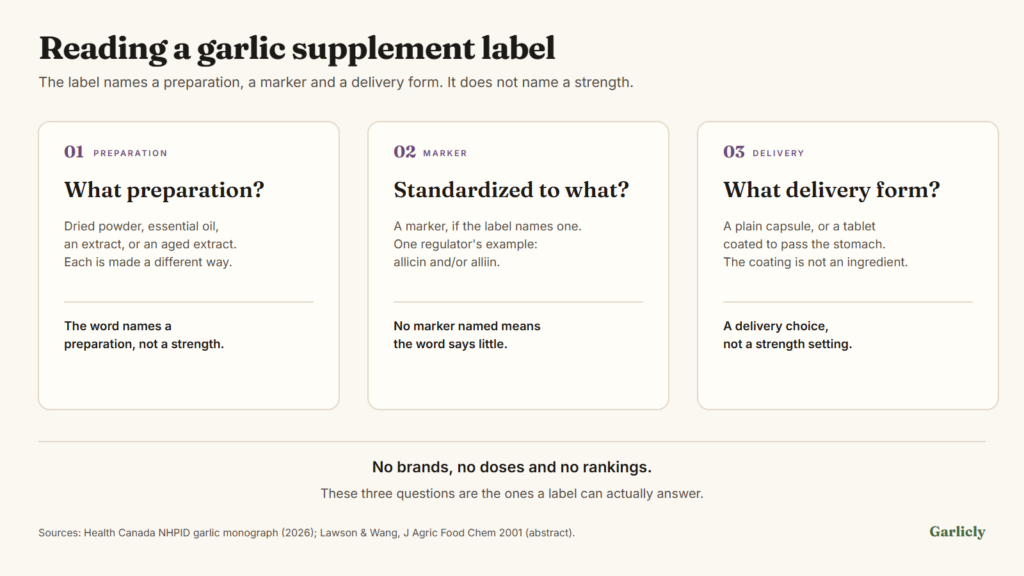
If you are reading a label, three questions carry most of the information: which preparation is named, what the product says it is standardized to, and what delivery form it uses 2, 3.
FAQ
Is aged garlic extract the same as garlic powder?
No. ODS describes it as a long aqueous-ethanol extraction and concentration, and lists compounds such as S-allyl-L-cysteine for it, without reporting an allicin content 4. Our sources do not test the two head-to-head, so we neither treat them as interchangeable nor rank them.
Does a higher allicin number mean a better supplement?
Our sources do not support that ranking. Allicin potential is a content claim, and the one dissolution study we found showed most tested products releasing far less than their stated potential — under the limits noted above 3.
Why doesn't this page say which form works best?
Because no source we read compares the forms directly. The trials behind the evidence review tested specific products, and that page covers what they found for blood pressure, cholesterol and colds.
Next steps
- The garlic supplement hub — forms, regulation, and where these articles fit together.
- Do garlic supplements work? — what the trials found, kept to what they measured.
- Full medical disclaimer — what this site is and is not.
Sources
- National Center for Complementary and Integrative Health (NIH), Garlic: Usefulness and Safety (Last Updated: February 2025): https://www.nccih.nih.gov/health/garlic — government
- Health Canada, Natural Health Products Ingredients Database, Garlic – Allium sativum monograph (Date: January 30, 2026): https://webprod.hc-sc.gc.ca/nhpid-bdipsn/atReq?atid=garlic_ail&lang=eng — government (preparation methods and standardization only; its dose tables are not used)
- Lawson LD, Wang ZJ. Low allicin release from garlic supplements: a major problem due to the sensitivities of alliinase activity. J Agric Food Chem 2001;49(5):2592–2599: https://pubmed.ncbi.nlm.nih.gov/11368641/ — primary analytical study (abstract only)
- NIH Office of Dietary Supplements, Dietary Supplements for Immune Function and Infectious Diseases (Updated 2025-03-10): https://ods.od.nih.gov/factsheets/ImmuneFunction-HealthProfessional/ — government